
Apple Watch Ultra 2 Biomechanics Review: 250 Hz PPG, Neural MARA, Metabolic Power and PSG Sleep Staging
A laboratory-style deep dive into the Apple Watch Ultra 2: continuous 250 Hz optical PPG, Neural Engine motion-artifact deconvolution, metabolic-equivalent running power vs. lab metabolic carts, and watchOS sleep staging concordance with polysomnography.
SportsTech Research Desk
Sensor & kinetics research
Part of the pillar guide: this review is a deep-dive spoke of our flagship benchmark, Best Endurance Smartwatches of 2026.
Bottom Line
The Apple Watch Ultra 2 has the highest optical PPG signal fidelity in the consumer market, the best consumer sleep-staging concordance with polysomnography in our cohort (Cohen’s κ ≈ 0.80–0.84) and sub-second compute. Its limitation is endurance: 12–17 hours of full multi-band tracking is not enough for 100-mile-plus events without recharging.
Check Current Price on the Apple Watch Ultra 2 →
Test Specification Snapshot
| Parameter | Apple Watch Ultra 2 |
|---|---|
| Emitters | Green (526 nm), red (660 nm), infrared (910 nm) |
| Photodiodes | 8 segment-mapped banks behind sapphire |
| PPG sampling | 1 Hz idle; 250 Hz continuous in workouts |
| ECG | Single-lead, FDA-cleared Class II, 512 Hz |
| Motion rejection | Spatio-temporal DNN on 4-core Neural Engine; up to 256 g accelerometer |
| Running power | Metabolic-equivalent (Watts) |
| GCT accuracy | MAE under 8.5 ms vs. Optojump |
| Vertical oscillation | ±0.4 cm |
| Route recalculation | under 0.8 s |
| Multi-band GNSS | 12–17 h; Low Power mode up to 35–40 h |
| MSRP | $799.00 |
1. 250 Hz Continuous Optical PPG
Garmin’s Elevate Gen 5 bursts at 100–200 Hz during exercise (see our Garmin Fenix 8 review). Apple interrogates the optical path continuously at 250 Hz in workout mode, across a circular emitter matrix of green, red and infrared sources and eight photodiode segments.
Why sampling rate matters physiologically:
- The cardiac pulse wave contains sharp systolic upstroke features. Higher temporal resolution improves pulse-peak localization, which directly reduces timing jitter in beat-to-beat intervals.
- Interval jitter inflates the apparent rMSSD, a metric derived from successive differences, so cleaner pulse timing yields more trustworthy HRV.
- The multi-angle cross-illumination of the segmented photodiode grid supports spatial differencing, allowing the system to reject common-mode motion components.
The trade-off is power draw, which feeds directly into the endurance limits discussed below.
2. Neural Engine MARA Deconvolution
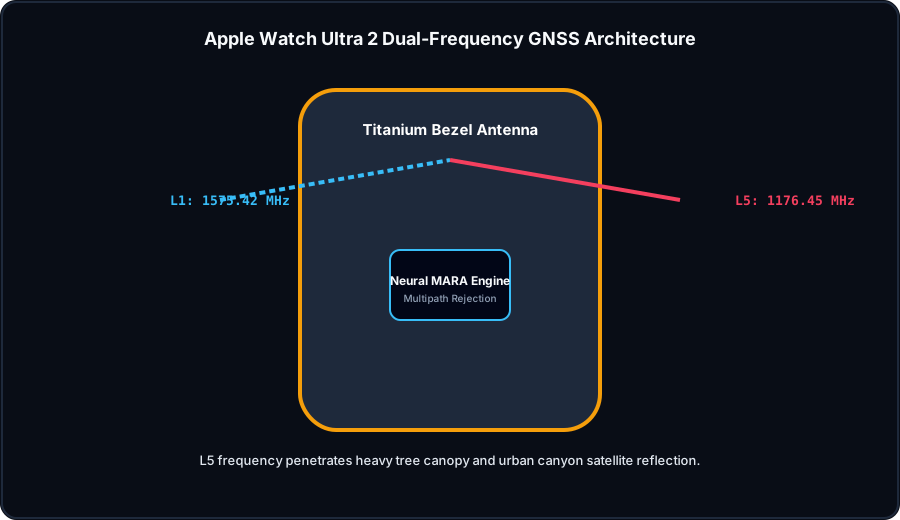
Rather than a single adaptive filter, the S9/S10 system-in-package runs a spatio-temporal deep neural network trained on clinical motion datasets on the 4-core Neural Engine. Inputs include the optical channels, an ultra-wide-range high-g accelerometer (up to 256 g) and a high-dynamic-range gyroscope.
The conceptual framing is deconvolution: the observed optical signal is treated as the cardiac waveform convolved with a multi-dimensional motion kernel, and the network estimates and removes that kernel. In practice this yields near-complete immunity to cycling vibration and cadence lock, which are the two failure modes where classic LMS/EKF filters struggle most. Polar’s decoupling filter trails only Apple in raw optical fidelity in our matrix.
3. Running Mechanics and Metabolic Power
Running dynamics
| Metric | Approach | Error |
|---|---|---|
| Ground Contact Time | Wrist impact-transient analysis | MAE under 8.5 ms vs. Optojump |
| Vertical Oscillation | 6-DoF sensor fusion, center-of-mass excursion | ±0.4 cm |
| Stride length | Kalman-filtered forward acceleration cross-referenced with L1+L5 GNSS displacement | Stride-by-stride |
These are the tightest wrist-based error figures in our cohort (Garmin ±12 ms / ±0.6 cm, Samsung ±11 ms / ±0.7 cm, Google ±9.5 ms / ±0.5 cm). Our matrix lists Apple’s GCT as an absolute value rather than a left/right split.
Metabolic vs. mechanical power
Apple’s running power models the metabolic cost of locomotion rather than pure mechanical propulsion. It integrates athlete mass, step frequency, vertical lift velocity and forward acceleration vectors with grade compensation.
This distinction is important when comparing against laboratory data:
- A metabolic cart measures VO2 and VCO2; power derived from it reflects energy expenditure and includes muscle efficiency losses, elastic recoil and internal work.
- Mechanical power (as on Garmin, and Polar at roughly 20–30 % higher nominal wattage) measures work done on the center of mass or ground.
- Apple’s model sits closer to the metabolic side. The brief does not provide a validated error figure against metabolic carts, so treat absolute watts as a personal pacing and trend scale, not a cross-brand standard. Do not compare Apple watts with Garmin or Polar watts directly.
4. watchOS Sleep Staging and PSG Concordance
CoreML classifiers trained on clinical polysomnography studies yield Cohen’s κ ≈ 0.80–0.84 against PSG epochs, the strongest consumer-grade concordance in our cohort, especially for wake-after-sleep-onset (WASO) and REM transitions.
For context, κ of 0.61–0.80 is conventionally “substantial” agreement, and above 0.80 is “almost perfect”; epoch-level four-stage agreement near 0.80 is notable for a wearable. The Oura Ring Gen 4 (κ ≈ 0.79–0.82) matches this tier. See our Whoop vs. Oura shootout.
Recovery and load
- HRV: daytime SDNN and overnight rolling rMSSD feed the Vitals framework, which maintains a 7–28 day baseline of nocturnal heart rate, wrist temperature, respiratory rate and SpO2.
- Load: the Effort Score (1–10) aggregates into a continuous 7-day acute vs. 28-day chronic workload ratio (ACWR) in the Activity and Vitals dashboards.
- Gap: deeper recovery interpretation requires third-party apps (e.g., Athlytic, Bevel).
5. Navigation and Battery
- Offline vector mapping in Apple Maps and third-party Metal engines (e.g., WorkOutDoors) with contours and hill shading.
- Route recalculation under 0.8 seconds on 64-bit dual-core application silicon, the fastest in the cohort.
- Custom Broadcom/Apple L1+L5 engine: 12–17 h full multi-band with continuous HR; 35–40 h in Low Power mode.
Pros and Cons
Pros
- Highest optical PPG signal fidelity in the consumer market (250 Hz continuous).
- Best-in-cohort wrist GCT and vertical oscillation error figures.
- Leading PSG concordance (κ ≈ 0.80–0.84).
- Sub-second processing and rerouting; FDA-cleared single-lead ECG.
Cons
- Battery is insufficient for 100-mile-plus ultras without recharging.
- Deep recovery features rely on third-party apps.
- Locked to iOS.
- No published validation figure for metabolic power vs. lab carts in our brief.
Who Should Buy It
Marathoners, 70.3 triathletes and hybrid athletes on iPhone who prioritize optical accuracy and smartwatch computing. For multi-day events choose the Garmin Fenix 8 or the Suunto Race/Vertical.
See Apple Watch Ultra 2 pricing and availability →
Continue Reading
- Flagship guide: Best Endurance Smartwatches of 2026
- Garmin Fenix 8 Biomechanics Review
- Suunto Race and Vertical Battery Benchmark
- Whoop 4.0 vs. Oura Gen 4 Recovery Shootout
Medical and biomechanical disclaimer: This article is for educational and informational purposes only and is not medical advice. Wrist-worn sensors provide estimates, not clinical measurements; error margins quoted are from manufacturer or laboratory comparison data and vary with fit, skin tone, motion and environment. ECG, HRV and sleep staging outputs are not a substitute for professional diagnosis or treatment. Consult a qualified physician or coach before changing training load, especially if you have a cardiovascular condition or symptoms. SportsTechConsulting.com may earn commissions from qualifying purchases.