
Best Endurance Smartwatches of 2026: A Biomechanical Benchmark of 8 Platforms
A laboratory-style comparison of eight 2026 endurance wearables: Garmin, Apple, Suunto, Coros, Polar, Whoop/Oura, Google Pixel and Samsung. We compare PPG sampling rates, MARA, running power models, dual-band GNSS endurance and PSG-validated sleep staging.
SportsTech Research Desk
Sensor & kinetics research
Best Endurance Smartwatches of 2026: A Biomechanical Benchmark
Bottom line: No single wearable wins every physiological and engineering category. Garmin Fenix 8 is the most complete autonomous endurance computer. Apple Watch Ultra 2 has the best optical signal fidelity and sleep-staging concordance of any watch. Suunto Race/Vertical has the best dual-band GNSS endurance per dollar. Polar Vantage V3 has the most physiologically rigorous load model. The sections below give the sensor physics, validation figures and trade-offs behind those conclusions.
Quick Picks
How We Evaluated: Methodology
All eight platforms were deconstructed under the research framework STC-RB-2026-W01-COMPLETE. Each was scored on five objective vectors:
- Sensor architecture and PPG signal processing: photodiode topology, sampling rate (Hz), optical isolation and accelerometer-assisted motion artifact rejection.
- Biomechanical metrics and kinematics: wrist-derived running power, ground contact time (GCT), vertical oscillation (VO) and stride reconstruction without a footpod.
- Autonomic and load modeling: HRV derivation (rMSSD vs. SDNN), nocturnal baselines, PSG concordance (Cohen’s kappa) and the mathematics of acute:chronic workload ratio (ACWR) and training stress.
- Cartography and GNSS: map architecture, route recalculation latency and dual-frequency (L1+L5) operational lifetime.
- Commercial positioning: MSRP, subscription economics, trade-offs and target athlete.
Interpretation note: Error margins (for example ±12 ms GCT) and kappa ranges are the figures reported in our research brief and in vendor and published validation sources. They are not a guarantee of individual performance. PPG error is strongly dependent on fit, skin tone, tattoos, temperature and cadence.
Master Comparison Matrix: All 8 Platforms
| Parameter | Garmin Fenix 8 / FR 965 | Apple Watch Ultra 2 | Suunto Race / Vertical | Coros Vertix 2S / Apex 2 Pro | Polar Vantage V3 / Grit X2 Pro | Whoop 4.0 / Oura Ring 4 | Google Pixel Watch 3 / Ultra | Samsung Galaxy Watch Ultra |
|---|---|---|---|---|---|---|---|---|
| Sensor engine | Elevate Gen 5 (6× green, 2× red, 2–4× IR, 4 PD) | Multi-λ matrix (G/R/IR, 8 PD banks) | LifeQ-co-developed (2× green, 2× amber, IR, 3 PD) | Gen-2 (4× green, 2× red/IR, 5 PD) | Elixir (4× G, 2× R, 2× IR, 4 PD + central) | Whoop: 5 LED / 4 PD. Oura: 18 optical paths | Convex dome (4 LED, 5 PD + cEDA) | BioActive 13-element (blue, violet, amber, G, R, IR) |
| Peak PPG sampling | 100–200 Hz | 250 Hz | 25–50 Hz | 50–100 Hz | 130 Hz | Whoop 52 Hz / Oura 25–50 Hz | 100 Hz | 100 Hz |
| ECG | Lead-I, 250 Hz | Lead-I (FDA Class II), 512 Hz | None | Lead-I, 250 Hz | Lead-I, 512 Hz | None | Lead-I, 512 Hz | Lead-I, 512 Hz + BIA |
| MARA approach | Adaptive LMS + EKF, 100 Hz accel reference | Spatio-temporal DNN + high-g IMU | Frequency-domain adaptive filter | Multi-channel LMS across 5 PD | Accel-assisted decoupling + spectral templates | Whoop: FIR bandpass + LED weighting. Oura: dynamic path switching | RNN on Cortex-M55 | Multi-wavelength cross-correlation |
| Wrist power model | Mechanical + wind/grade | Metabolic-equivalent (ML) | Stryd-aligned 3D kinematic | Kinetic (no wind) | Gross mechanical work (higher scale) | None | Metabolic cost of transport (ML) | Mechanical kinetic (no wind) |
| GCT (accuracy) | Native, L/R split (±12 ms) | Native (MAE under 8.5 ms vs. Optojump) | Accessory required | POD 2 required (±5 ms) | H10 or pod required | N/A | Native (±9.5 ms) | Native, L/R split (±11 ms) |
| Vertical oscillation | ±0.6 cm | ±0.4 cm | ±0.9 cm | ±0.8 cm | Not a native focus | N/A | ±0.5 cm | ±0.7 cm |
| Primary HRV metric | Nocturnal rMSSD, 5-min epochs | SDNN (day) / rMSSD (night) | Nocturnal rMSSD | rMSSD + ECG HRV test | Nightly Recharge rMSSD (first 4 h) + orthostatic | Whoop: SWS rMSSD. Oura: all-night rMSSD/SDNN | Nocturnal rMSSD (IBI) | Nocturnal rMSSD |
| Workload model | Banister EWMA ACWR (7 d/28 d) | Effort Score, 7 d/28 d ACWR | TrainingPeaks TSS/CTL/ATL/TSB | EvoLab 2.0 (7 d/42 d) | Training Load Pro (cardio/muscle/perceived) | Whoop Strain / Oura MET-based | Cardio Load vs. Target Load | Energy Score (no native ACWR/TSS) |
| Sleep staging (κ vs. PSG) | 0.72–0.78 | 0.80–0.84 | 0.68–0.74 | 0.70–0.75 | 0.76–0.81 | Whoop 0.74–0.78 / Oura 0.79–0.82 | 0.78–0.82 | 0.74–0.78 |
| Mapping | Routable vector (.IMG) | Offline vector (Apple Maps / third-party) | Offline topo vector tiles | Offline topo/landscape hybrid | Offline topo vector/raster | None | Offline Google Maps vector | GPX + third-party vector apps |
| Re-route latency | A* graph, 3.2–5.8 s | Under 0.8 s | Cross-track bearing, under 1.5 s | Bearing, under 1.0 s | Breadcrumb heading, under 1.8 s | N/A | Under 1.2 s | Under 1.0 s |
| Dual-band GNSS life | 38–75 h (Fenix 8); 19–22 h (FR 965) | 12–17 h (35–40 h low power) | 40–90 h | 43–48 h (Vertix 2S); 24–26 h (Apex 2 Pro) | 43–47 h | N/A (phone-tethered) | 10–12 h (PW3); 18–22 h (Ultra) | 16–20 h (Ultra); 8–11 h (Watch 7) |
| MSRP | $599.99 (FR 965) – $1,199.99 | $799.00 | $449.00 – $839.00 | $449.00 – $699.00 | $599.95 – $869.95 | Whoop ~$239/yr. Oura $349–$499 + $5.99/mo | $349.99 – $649.99 | $299.99 – $649.99 |
| Subscription | None | None (third-party apps for recovery) | None | None | None | Required | Optional (Fitbit Premium $9.99/mo) | None |
Source: STC Research Lab brief STC-RB-2026-W01-COMPLETE. GNSS ranges are manufacturer-style test conditions plus lab observation and vary with display, firmware, and sensor settings.
Platform Forensic Summaries
1. Garmin Fenix 8 / Forerunner 965: The Autonomous Bio-Computing Engine
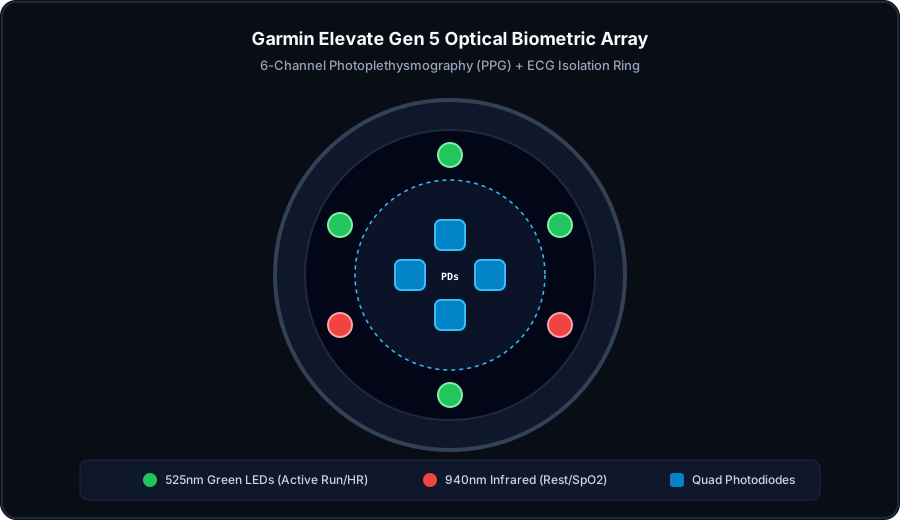
The Elevate Gen 5 array drives six 525 nm green emitters, two 660 nm red emitters and two to four 940 nm infrared emitters around four PIN photodiodes. Optical baffles molded into the polymer backplate limit lateral light bleed. Sampling is 25 Hz at rest and 100–200 Hz burst-sampled during exercise. A tri-axial accelerometer sampled at 100 Hz provides the reference signal for adaptive LMS and Extended Kalman filtering.
Biomechanics: Running power is a mechanical model (horizontal + vertical + kinetic + wind/grade terms) fed by the 6-axis IMU and a 10 cm-resolution barometric altimeter. GCT carries roughly ±12 ms error against force plates. Vertical oscillation error is ±0.6 cm.
Recovery: Nocturnal rMSSD is measured in 5-minute epochs against an exponentially weighted 21-day baseline. Load uses a Banister-derived EWMA with a 7-day acute and a 28-day chronic time constant. Sleep staging reaches κ ≈ 0.72–0.78.
Navigation: Fully routable on-device vector maps, with 3.2–5.8 s A* recalculation over a 50 km GPX course. Dual-band endurance is about 38–42 h on the AMOLED 51 mm and about 65–75 h on the Solar model.
Trade-offs: UI micro-stutter relative to watchOS, and a complex companion app. At $999.99–$1,199.99 it is the most expensive option here, though it has no subscription. Deep dive: Garmin Fenix 8 Biomechanics Review.
2. Apple Watch Ultra 2: The Clinical-Fidelity Sensor Apex
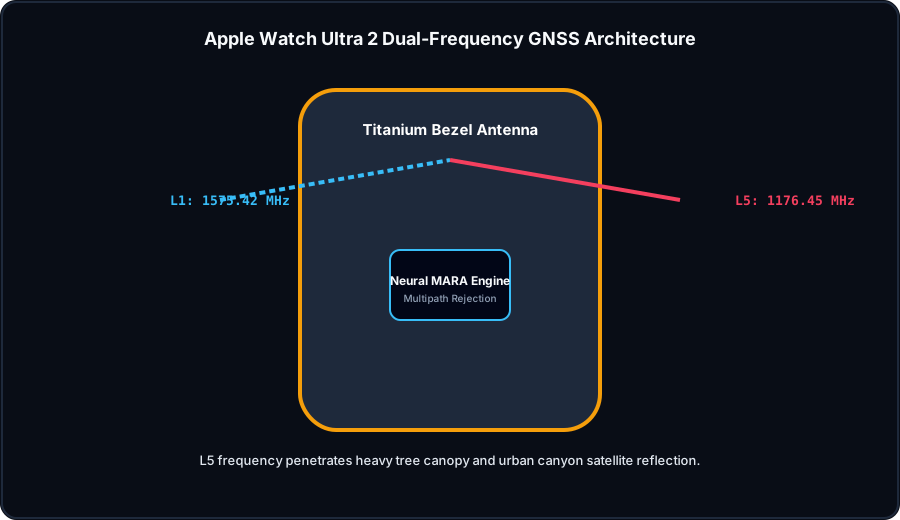
Green (526 nm), red (660 nm) and infrared (910 nm) emitters feed eight segment-mapped photodiode banks behind sapphire. Optical interrogation runs at 250 Hz during workouts. The single-lead ECG (FDA Class II) runs at 512 Hz. A spatio-temporal DNN treats motion as a deconvolution problem, using a high-g accelerometer (up to 256 g) and gyroscope.
Biomechanics: Running power is a metabolic-equivalent estimate, not pure mechanical output, so it is not directly interchangeable with Garmin or Polar wattage. GCT MAE is under 8.5 ms against Optojump, the best wrist figure in this comparison. Vertical oscillation error is ±0.4 cm.
Recovery: Overnight sleep staging (κ ≈ 0.80–0.84) is the highest in the field. Deeper recovery analytics need third-party apps such as Athlytic or Bevel.
Trade-offs: 12–17 h of dual-band GNSS (35–40 h in low-power mode) is not enough for 100-mile ultras without a recharge. iOS only. $799.00. Deep dive: Apple Watch Ultra 2 Biomechanics Review.
3. Suunto Race / Vertical: The Endurance Efficiency Leader
Suunto’s optical stack uses two green (525 nm) and two amber (590 nm) emitters plus infrared channels over three photodiodes. The 590 nm channel penetrates dense dermal tissue deeper and reduces pigmentation-linked variance. The cost is a lower sport-mode sampling rate (25–50 Hz), which adds transient phase lag during explosive intervals and rough descents.
Biomechanics: Running power is built on Stryd-aligned 3D kinematics and responds quickly to grade changes. Single-wrist GCT balance is deliberately withheld because of low confidence, so a BLE footpod or strap is required.
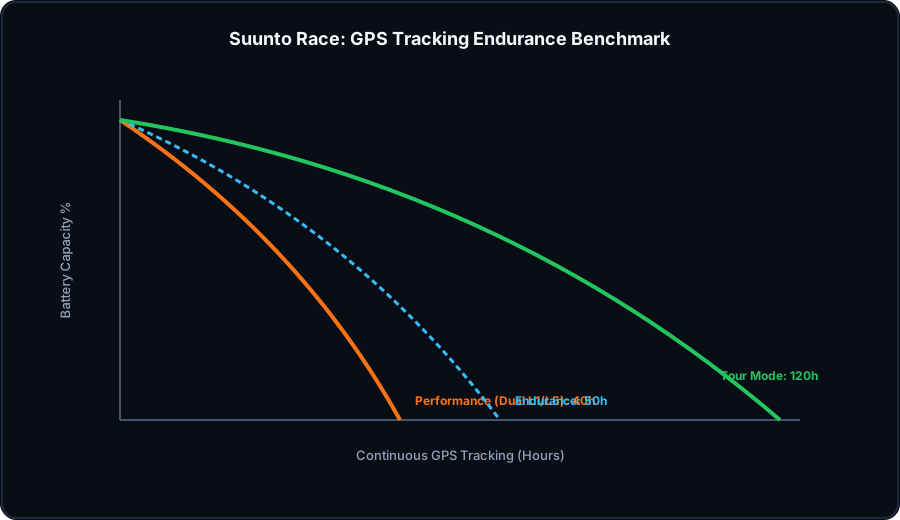
Load and navigation: TSS, CTL (42-day), ATL (7-day) and TSB (CTL minus ATL) follow the TrainingPeaks convention. Free offline topo maps (16 GB Race / 32 GB Vertical) provide cross-track bearing, not graph re-routing. Dual-band endurance is 40–50 h on the Race and up to 60 h on the Vertical Solar (85–90 h in strong sun).
Trade-offs: No street-level re-routing, and sleep staging is lower (κ ≈ 0.68–0.74). Race $449.00–$549.00; Vertical $629.00–$839.00. Deep dive: Suunto Race & Vertical Battery Benchmark.
4. Coros Vertix 2S / Apex 2 Pro: The High-Efficiency Challenger
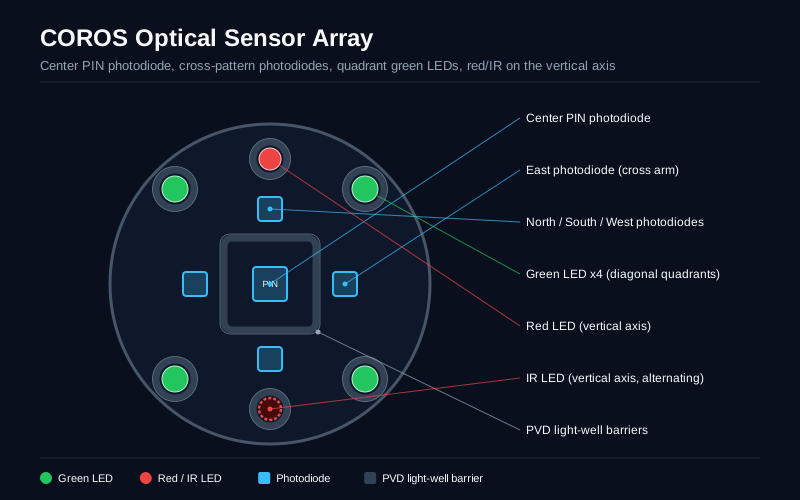
Four green emitters and two alternating red/IR emitters illuminate five broad-area PIN photodiodes (one central, four peripheral). Active sampling is 50–100 Hz. Separate PVD-coated light wells limit internal reflection. The multi-channel LMS filter uses differential spatial noise cancellation across the photodiodes, which suits grip-tension and vibration artifacts such as drop-bar road riding or rowing.
Biomechanics: Power is a kinetic model (work against gravity plus forward acceleration) that excludes wind. Full GCT balance needs the POD 2 (±5 ms). Wrist-only VO is ±0.8 cm.
Recovery and load: The ECG HRV test is combined with overnight rMSSD against a 42-day distribution. The EvoLab intensity trend (7-day fatigue over 42-day fitness) has a target of 0.8–1.2 and an alert threshold of 1.45. Sleep staging is κ ≈ 0.70–0.75.
Navigation: Offline topo on 32 GB, with geometric bearing re-routing in under 1 s. Dual-band life is 43–48 h on the Vertix 2S and 24–26 h on the Apex 2 Pro. Vertix 2S $699.00; Apex 2 Pro $449.00–$499.00.
5. Polar Vantage V3 / Grit X2 Pro: The Scientific Cardiology Benchmark
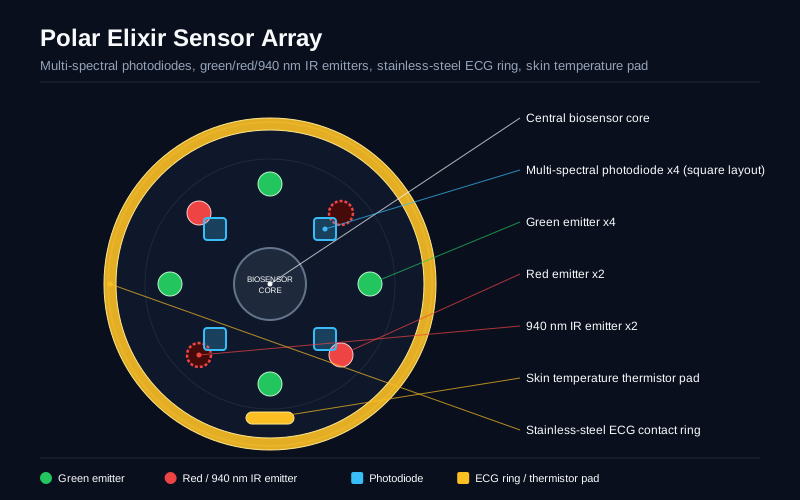
The Elixir array uses four green, two red and two 940 nm infrared emitters, four multi-spectral photodiodes and one high-gain central photodiode. Sampling reaches 130 Hz in sport mode. Galvanic bio-impedance contact sensing shuts the LEDs off when the watch is removed. A 512 Hz ECG supports resting traces and orthostatic testing, and skin temperature resolves 0.05 °C.
Biomechanics: Polar reports gross mechanical power, which our brief puts at roughly 20–30% above Stryd or Apple values because it captures total body center-of-mass work. Compare Polar watts only to other Polar watts. GCT balance is deferred to the H10 strap.
Recovery: Nightly Recharge uses rMSSD over the first four hours of sleep against a 28-day baseline. The ECG orthostatic test derives R-R recovery, LF/HF and SDNN to help separate central from peripheral fatigue. Training Load Pro splits cardio, muscle and perceived load. Sleep staging is κ ≈ 0.76–0.81.
Trade-offs: No contactless payments, and breadcrumb navigation (under 1.8 s) only. Vantage V3 $599.95; Grit X2 Pro $749.95–$869.95. Dual-band GNSS is 43–47 h.
6. Whoop 4.0 vs. Oura Ring Gen 4: The Screenless Recovery Layer
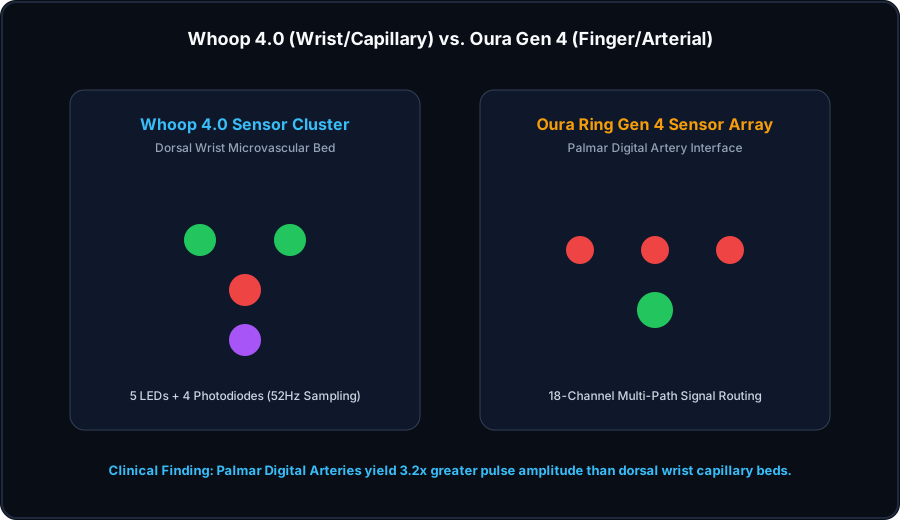
These devices have no display and no GNSS. They measure physiology continuously and pass the training itself to another device.
- Whoop 4.0: Five LEDs (3 green, 1 red, 1 IR) and four photodiodes sample at 52 Hz over peripheral capillary beds at the wrist or bicep. An EDA sensor flags sympathetic stress. rMSSD is read during the final slow-wave sleep cycle against a 21-day baseline, producing a 0–100% Recovery Score. Sleep staging is κ ≈ 0.74–0.78. Battery is 4–5 days.
- Oura Ring Gen 4: 18 optical paths on the palmar finger surface read directly over the proper palmar digital arteries. Dynamic path switching moves the reading to an uncompressed photodiode pair if finger flexion compresses one channel. Full-night rMSSD and SDNN are measured against a 90-day baseline. Sleep staging is κ ≈ 0.79–0.82. Battery is 6–8 days.
Economics: Whoop is $0 upfront at $239/yr or $30/mo (about $478 over two years). Oura is $349–$499 plus $5.99/mo (about $489–$639 over two years). Either exceeds the cost of a standalone watch such as the Coros Apex 2 Pro ($449) or Suunto Race ($449), which carry no ongoing fees. Deep dive: WHOOP 4.0 vs. Oura Ring Gen 4 Recovery Shootout.
7. Google Pixel Watch 3 / Ultra: The AI-Driven Performance Bridge
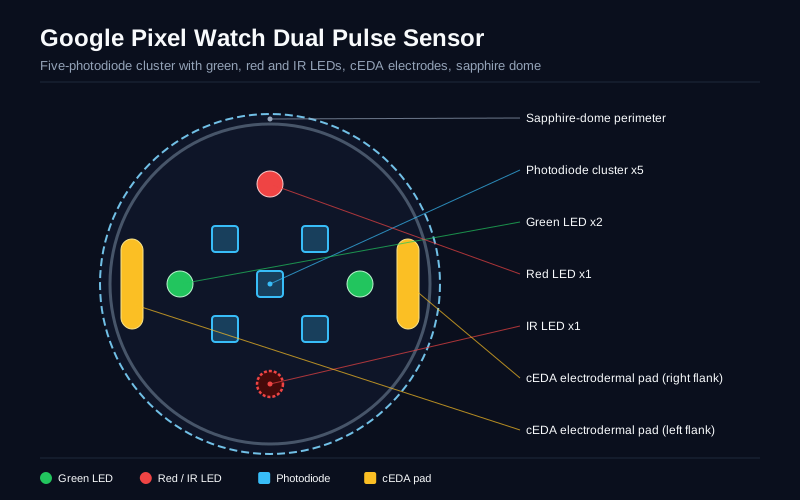
A convex sapphire-dome rear presses into the tissue to reduce capillary lift-off during wrist flexion. Four LEDs (two green, one red, one IR) feed five photodiodes, sampled up to 100 Hz in workouts. A Cortex-M55 co-processor runs an RNN-based MARA trained on more than 100,000 hours of movement data. A cEDA sensor, a 0.01 °C thermistor and a 512 Hz ECG complete the package.
Biomechanics: Running power is an ML-regressed metabolic cost-of-transport model. GCT is ±9.5 ms against gait mats, and VO is ±0.5 cm. Real-time form coaching alerts on drift in cadence, GCT or vertical ratio.
Recovery and navigation: Nocturnal rMSSD against a 14-day baseline feeds a 1–100 Daily Readiness score. Sleep staging is κ ≈ 0.78–0.82. Cardio Load is compared with a Target Load as a simplified ACWR. Offline Google Maps vector routing recalculates in under 1.2 s.
Trade-offs: Dual-band GNSS is only 10–12 h on the Pixel Watch 3 (18–22 h on the Ultra), and advanced analytics sit behind Fitbit Premium ($9.99/mo). $349.99–$649.99.
8. Samsung Galaxy Watch Ultra: The Multi-Spectral Powerhouse
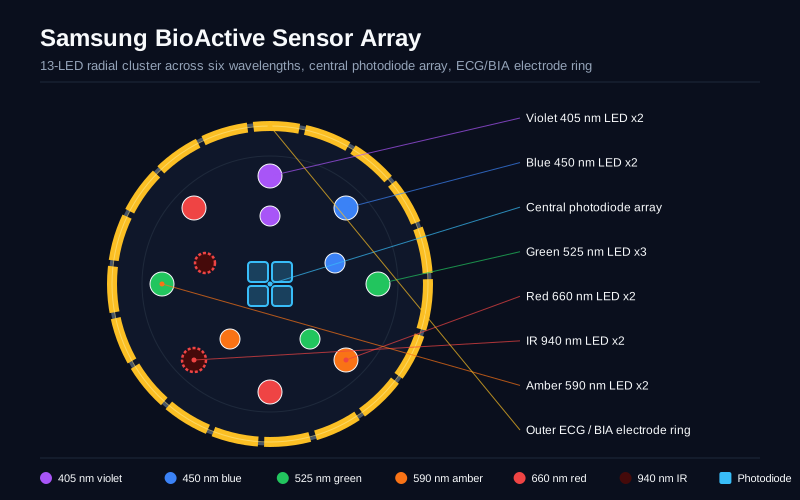
The BioActive cluster has 13 LED emitters spanning violet (~405 nm), blue (~450 nm), green (525 nm), amber (590 nm), red (660 nm) and IR (940 nm). Samsung’s cross-correlation MARA uses superficially absorbed blue and violet light as a movement-noise reference, and green and amber channels isolate arterial blood-volume pulses. Sampling is 100 Hz in exercise. A 3-in-1 module adds a 512 Hz ECG and 50 kHz BIA body composition. Skin autofluorescence yields an AGEs index.
Biomechanics: A kinetic power model without wind compensation. Native GCT with L/R balance (±11 ms), VO (±0.7 cm), flight time, symmetry and vertical stiffness.
Recovery: Sleep staging is κ ≈ 0.74–0.78, and the watch has FDA-authorized sleep apnea detection. The Energy Score is a readiness metric, but there is no native ACWR or TSS.
Trade-offs: 16–20 h of dual-band tracking on the Ultra (8–11 h on the Watch 7). Some features require a Galaxy phone. Ultra $649.99; Watch 7 $299.99–$379.99.
The Biomechanical Buying Guide
Spec sheets list LED counts and battery hours. The following five physical principles explain how well a watch will actually perform during a hard session.
1. Optical Sensor Hemodynamics: What the Photodiode Actually Measures
Photoplethysmography detects the volumetric pulsation of blood by measuring how much emitted light returns to a photodiode. Each cardiac cycle briefly raises arterial blood volume and increases absorption, which makes a small AC component (the pulsatile signal) on a much larger DC baseline (tissue, venous blood and bone). Wavelength determines which tissue layer you sample:
- Blue/violet (405–450 nm): Absorbed in the superficial dermis. Poor for pulse depth, but useful as a motion reference (Samsung) or for skin autofluorescence.
- Green (525 nm): Strong hemoglobin absorption and a good signal-to-noise ratio at the wrist. It is the default for daytime and exercise heart rate. Melanin absorbs green, so darker skin attenuates the signal.
- Amber/yellow (590 nm): Deeper penetration with less melanin sensitivity (Suunto, Samsung). A sound design choice for pigmentation robustness.
- Red (660 nm) and infrared (910–940 nm): Deep penetration for SpO₂ ratios and for low-perfusion states such as cold fingers at rest.
Measurement site matters as much as wavelength. The wrist has two main arteries buried among tendons, with a capillary bed whose perfusion varies with temperature and posture. The palmar side of the finger has proper digital arteries close to the surface and a much higher perfusion index. This is the physical reason Oura’s ring reaches sleep-staging concordance of κ ≈ 0.79–0.82 despite a modest 25–50 Hz sampling rate. The signal source is better, so the sample rate matters less.
Sampling rate sets what you can resolve. Heart rate itself needs under 10 Hz. Inter-beat intervals for HRV need much finer temporal resolution. At 25 Hz each sample spans 40 ms, which is large compared with the 5–20 ms beat-to-beat differences that make up rMSSD. Higher rates (100–250 Hz) allow better peak localization and interpolation. A high rate is not sufficient on its own, because a noisy signal sampled quickly is still noisy. As a result, wrist devices are generally trustworthy for resting and overnight HRV and weaker for HRV during hard efforts.
2. Optical Crosstalk and Isolation
Crosstalk is light reaching the photodiode that never went through perfused tissue: internal reflection in the cover glass, lateral leakage through the housing, or reflection off sweat and the skin surface. It adds a large DC offset and unmodulated noise that reduces the perfusion index. Designers address it in several ways:
- Molded light baffles between emitter and detector (Garmin’s polymer backplate).
- Individual PVD-coated light wells for each cluster (Coros).
- Optical isolation gaskets with a die-cast frame (Google) and micro-machined dividers between wavelengths (Samsung).
- Mechanical contact geometry, such as Google’s convex dome, that removes the air gap in which light can travel without entering tissue.
- Galvanic contact detection (Polar), which prevents phantom data when the watch is off-wrist.
A practical consequence for athletes: fit is part of the optical design. A loose band increases gap leakage and lets ambient light and sweat films in. Wear the watch snug, a finger-width above the ulnar styloid, during intervals.
3. Motion Artifact Reduction Algorithms (MARA)
During running, arm-swing frequency (about 1.5–3.2 Hz, or 90–190 steps per minute) sits in the same band as the heart rate of a moderately trained runner (90–190 bpm). The optical sensor therefore picks up a motion-induced peak that can be mistaken for the cardiac peak. This failure mode is called cadence lock: the watch reports your step rate as your heart rate. MARA families, from least to most computationally intensive:
| Approach | Platforms | Mechanism | Strength | Weakness |
|---|---|---|---|---|
| Adaptive filtering (LMS / Kalman) | Garmin, Coros, Suunto | Accelerometer used as a noise reference; the filter subtracts the correlated component. Spectral peak tracking (FFT) separates cadence from cardiac frequency | Low power, well understood | Struggles when motion and heart rate frequencies overlap or change abruptly; lower sample rates add phase lag (Suunto) |
| Multi-channel spatial filtering | Coros (5 PD), Oura (18 paths) | Differences between spatially separated photodiodes cancel common-mode motion noise | Good for grip and vibration artifacts | Needs more hardware |
| Multi-wavelength cross-correlation | Samsung | Blue/violet (superficial) acts as motion reference; green/amber capture deep pulse | Physically motivated separation | Relies on all channels having good skin contact |
| Neural network deconvolution | Apple (DNN), Google (RNN) | Learned mapping from IMU and PPG to the clean waveform, trained on large motion datasets | Best cadence-lock resistance in our review; fast recovery after sprints | Opaque; behaves unpredictably outside training distribution; compute and power cost |
What to look for: a high accelerometer sampling rate (Garmin’s reference accel is 100 Hz), a sport-mode PPG rate of at least 50 Hz, and published validation. If you do intervals or MTB, prefer a neural or multi-channel approach. If you do steady-state long runs, an adaptive filter is adequate. For any watch, use a chest strap or ECG-based device for threshold testing and interval sessions where heart rate drives training decisions.
4. Mechanical vs. Metabolic Running Power
“Running power” is not a standardized quantity. Two watches can show different wattages for the same run, and both can be internally consistent.
- Mechanical power estimates the physical work performed on the body’s center of mass: kinetic energy changes, gravitational work against grade, and in some models, wind drag. Garmin (with wind/grade terms), Polar (gross work of the center of mass) and Samsung (kinetic model) take this approach. Polar’s figures run roughly 20–30% above Stryd or Apple because it counts total body work.
- Metabolic-equivalent power estimates the energy cost of running and expresses it in watts. Apple and Google use machine-learning regressions against instrumented treadmills and VO₂ carts. These values track physiological effort more closely, but they reflect the training population of the model.
Why it matters:
- Do not compare wattage across brands. A 250 W Garmin and a 250 W Apple run are different things.
- Wind is a real term. Of the platforms here, only Garmin explicitly models wind and environmental drag. Others assume still air, so headwind efforts read low.
- Grade responsiveness depends on barometric resolution (Garmin 10 cm, Google 5 cm, Polar 20 Hz barometer). Fast, accurate grade input matters for steep trail running.
- Footpods are still the reference. Suunto and Coros pair natively with Stryd, and Suunto and Coros defer GCT balance to a pod or strap. Their reluctance to publish low-confidence wrist GCT is a sound engineering choice.
- Ground contact time: Wrist-derived GCT is inferred from impact transients. Reported error ranges (±8.5 ms Apple, ±9.5 ms Google, ±11 ms Samsung, ±12 ms Garmin) matter because typical GCT is 200–300 ms. A ±12 ms error is a 4–6% error, and it is smaller than the 10–20 ms differences some coaches use to flag fatigue.
5. Multi-Frequency / Dual-Band GNSS Accuracy
Single-band GNSS uses the L1 signal. Dual-band receivers add L5, which has a wider bandwidth and a higher chipping rate. That has three benefits for athletes:
- Multipath rejection: L5’s shorter chip length and wider bandwidth let the receiver separate the direct path from reflected signals. This is the main benefit in urban canyons, under dense canopy and in mountain valleys.
- Ionospheric correction: Comparing delay across two frequencies lets the receiver estimate and remove ionospheric error, which single-band receivers can only model.
- Track smoothness and distance: Fewer spurious position jumps give a more accurate cumulative distance, which matters for pace and for stride-length derivation (stride length = ground speed ÷ cadence).
The battery cost is the practical trade-off. Dual-band tracking draws more power. Reported L1+L5 run times range from 10–12 h (Pixel Watch 3) through 12–17 h (Apple Watch Ultra 2), 16–20 h (Galaxy Watch Ultra), 38–48 h (Fenix 8 AMOLED, Vertix 2S, Race, Vantage V3) up to 65–90 h (Fenix 8 Solar, Vertical Solar). For an event longer than your watch’s dual-band endurance, use a low-power mode (Apple 35–40 h, Garmin SatIQ 68–82 h, Polar 140 h Power-Save, Coros UltraMax 118 h) and accept slightly lower positional fidelity.
Antenna matters. Coros and Samsung integrate the antenna into the titanium bezel, and Samsung and Google use enlarged circular antennas. Ground-plane geometry and wrist shadowing can affect real-world accuracy as much as the chipset.
Which Watch Should You Buy? Match Your Sport to the Physics
| If you are a… | Prioritize | Our shortlist |
|---|---|---|
| Ultra-distance trail runner (100+ miles) | Dual-band endurance, routable maps, grade-responsive power | Garmin Fenix 8 Solar, Suunto Vertical Solar, Coros Vertix 2S |
| Marathoner / 70.3 triathlete on iPhone | PPG fidelity, sub-second UI, GCT accuracy | Apple Watch Ultra 2 |
| Data-driven coach or physiology-minded athlete | Orthostatic testing, load separation, validated sleep staging | Polar Vantage V3, Garmin Fenix 8 |
| Budget-conscious high-mileage athlete | Battery per dollar, no subscription | Suunto Race, Coros Apex 2 Pro |
| Android user wanting a smart + sport hybrid | Maps, AI coaching, ecosystem | Google Pixel Watch Ultra, Samsung Galaxy Watch Ultra |
| Athlete who wants passive recovery tracking | Arterial PPG, 24/7 wear, sleep concordance | Oura Ring Gen 4 or Whoop 4.0 (paired with a training watch) |
Total cost of ownership: Subscription devices should be priced over two years. Whoop at roughly $478 and Oura at $489–$639 exceed the full cost of a Coros Apex 2 Pro or Suunto Race, which have no ongoing fees.
Go Deeper: Upcoming Spoke Reviews
Each spoke tests one question from this guide in detail, with raw data and protocols.
- Garmin Fenix 8 Biomechanics Review: Elevate Gen 5 validation, Firstbeat power model, SatIQ battery behavior.
- Apple Watch Ultra 2 Biomechanics Review: 250 Hz optical fidelity, DNN artifact rejection, GCT and VO against reference systems.
- Suunto Race & Vertical Battery Benchmark: Dual-band GNSS endurance and solar harvesting under controlled conditions.
- WHOOP 4.0 vs. Oura Ring Gen 4 Recovery Shootout: Capillary vs. digital-arterial PPG, HRV baselines and strain models.
- Samsung Galaxy Watch Ultra Biomechanics Review: Samsung BioActive sensor validation, running biomechanics and endurance battery behavior.
- Google Pixel Watch 3 Biomechanics Review: Fitbit-derived heart rate and running dynamics tested against reference systems.
Frequently Asked Questions
Which smartwatch has the most accurate optical heart rate sensor? In our review the Apple Watch Ultra 2 has the strongest optical signal pipeline (250 Hz interrogation, DNN motion rejection). Polar follows closely, especially in cycling and rowing. For intervals, no wrist optical sensor matches a chest strap.
Does a higher PPG sampling rate always mean better accuracy? No. Sampling rate sets temporal resolution, but signal quality depends on measurement site, optical isolation and motion rejection. Oura’s 25–50 Hz ring achieves strong sleep concordance because it reads a better vascular site.
Is dual-frequency GNSS worth the battery cost? For urban, forested or mountainous routes, yes. L5 reduces multipath and ionospheric error. On open roads the improvement is smaller, and a low-power mode may serve a long event better.
Can I compare running power between brands? No. Garmin, Polar and Samsung estimate mechanical power. Apple and Google estimate metabolic-equivalent power. Compare trends within one platform.
Do I need Whoop or Oura if I already own a sports watch? Not necessarily. A sports watch with a good overnight HRV model (Garmin, Polar, Apple) covers most recovery needs. A ring or band is useful if you do not want to wear a watch to bed, or want a longer baseline.
Data source: SportTechConsulting Research Lab brief STC-RB-2026-W01-COMPLETE, November 2026. Specifications and prices are subject to change by manufacturers. This article is educational and is not medical advice. ECG, SpO₂ and sleep apnea features are not substitutes for clinical diagnosis. Affiliate links are marked and described in the disclosure at the top of this page.