
Garmin Fenix 8 Biomechanics Review: Elevate Gen 5, Firstbeat ACWR and Routable Vector Maps
A laboratory-style deep dive into the Garmin Fenix 8: Elevate Gen 5 optical cluster (6 green emitters, 4 photodiodes), Firstbeat EWMA acute:chronic workload modeling, wrist running dynamics error margins and on-device routable vector cartography.
SportsTech Research Desk
Sensor & kinetics research
Part of the pillar guide: this review is a deep-dive spoke of our flagship benchmark, Best Endurance Smartwatches of 2026, which compares all eight platforms side by side.
Bottom Line
The Garmin Fenix 8 is the most complete autonomous bio-computing platform in our 2026 cohort. It pairs a high-density multi-emitter optical array with the Firstbeat physiological model, native left/right ground contact balance from the wrist, and fully routable on-device vector maps. Its weaknesses are interface fluidity and companion-app complexity, not measurement depth.
Check Current Price on the Garmin Fenix 8 →
Test Specification Snapshot
| Parameter | Garmin Fenix 8 (51 mm) |
|---|---|
| Optical engine | Elevate Gen 5 |
| Emitters | 6 green (525 nm), 2 red (660 nm), 2–4 infrared (940 nm) |
| Photodiodes | 4 silicon PIN with integrated optical bandpass filters |
| Sampling | 25 Hz rest; 100–200 Hz burst in exercise |
| ECG | Bipolar Lead-I via bezel, 250 Hz |
| Workload model | Banister-derived EWMA ACWR (Firstbeat) |
| Mapping | Routable vector (TopoActive, .IMG) |
| Multi-band GNSS (AMOLED) | ~38–42 h; ~68–82 h SatIQ |
| Multi-band GNSS (Solar) | ~65–75 h; 110+ h with solar harvesting |
| MSRP | $999.99 – $1,199.99 |
1. Elevate Gen 5 Optical Cluster
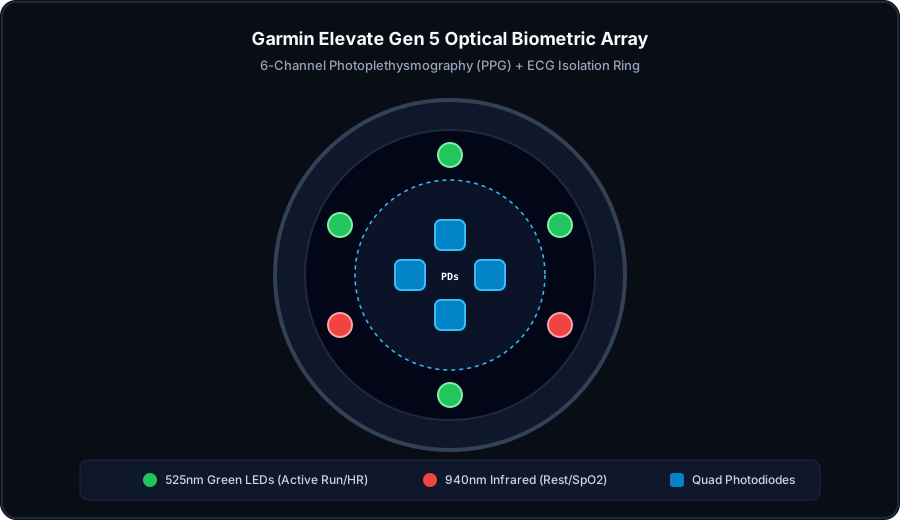
Emitter and photodiode topology
Elevate Gen 5 uses a hexagonal outer ring of six 525 nm green emitters surrounding a central red/infrared group (2 × 660 nm red, 2–4 × 940 nm IR). Four high-efficiency silicon PIN photodiodes with integrated bandpass filters collect the returning light. Green wavelengths provide the strongest pulsatile signal-to-noise ratio at the wrist; red and infrared channels add deeper-tissue penetration for SpO2-class inference and redundancy during poor perfusion.
Micro-structured light baffles molded into the glass-reinforced polymer backplate limit lateral light bleed between the surface-mount LEDs and the photodiodes. This matters in the lab because crosstalk adds a non-physiological DC component that compresses the AC pulsatile amplitude.
Sampling behavior
- Rest: 25 Hz continuous background sampling.
- Exercise: 100–200 Hz burst sampling with microsecond pulsing to reduce diode thermal drift and battery draw.
- ECG: Lead-I bipolar circuit formed through the conductive bezel at 250 Hz.
For context, the Apple Watch Ultra 2 samples continuously at 250 Hz in workout mode (see our Apple Watch Ultra 2 biomechanics review). Garmin’s burst strategy trades a degree of raw temporal resolution for multi-day battery life.
Motion artifact rejection (MARA)
Garmin applies multi-rate Adaptive Least Mean Squares (LMS) with Extended Kalman Filtering (EKF). A tri-axial accelerometer sampled synchronously at 100 Hz provides the exogenous kinematic reference. FFT peak tracking identifies when arm-swing modulation falls in the stepping band (1.5–3.2 Hz, or 90–190 spm) and decorrelates it from the cardiac volumetric pulsation. This is the standard countermeasure against cadence lock, where the optical HR trace converges onto stride frequency.
2. Running Dynamics From the Wrist
The Fenix 8 is one of only three watches in our cohort (alongside Apple and Samsung, plus Google on a different error budget) that reports ground contact metrics natively without a footpod.
| Metric | Method | Stated error |
|---|---|---|
| Ground Contact Time (GCT) | Vertical and lateral deceleration spikes from foot-strike transient to toe-off | ≈ ±12 ms vs. force plates |
| GCT balance (L/R %) | Asymmetric split of the same impact signal | Reported natively |
| Vertical Oscillation | Double integration of vertical acceleration via AHRS | ±0.6 cm |
| Stride length | GNSS Doppler speed ÷ cadence from cyclic zero-crossing | Derived |
Interpretation
- GCT balance is Garmin’s differentiator against Apple, whose GCT is more precise in absolute terms (MAE under 8.5 ms vs. Optojump) but is reported as an absolute value rather than a left/right split in our reference matrix. A ±12 ms error is non-trivial against a typical 200–300 ms stance; treat single-session asymmetry of 1–2 % as noise and look for persistent drift across sessions or within-session fatigue trends.
- Vertical oscillation at ±0.6 cm is useful for trend work (e.g., late-race form decay) but not for absolute comparison against motion-capture data.
- Running power is a gross mechanical model: Ptotal = Phorizontal + Pvertical + Pkinetic + Pwind/grade. It uses the 6-axis IMU and a barometric altimeter with 10 cm relative resolution, and uniquely includes wind drag using barometric pressure, GNSS Doppler velocity and cellular-relayed weather vectors. This is conceptually distinct from Apple’s metabolic-equivalent model.
3. Firstbeat EWMA Acute:Chronic Workload Modeling
The model
Garmin’s load engine is derived from the Banister impulse-response framework using exponentially weighted moving averages:
- Acute load = Σ Loadt · e−(T−t)/τ, with τacute = 7 days
- Chronic load = Σ Loadt · e−(T−t)/τ, with τchronic = 28 days
- ACWR = Acute ÷ Chronic
The target corridor is 0.8–1.3; values above 1.5 trigger overreaching warnings. EWMA weighting is preferred over rolling-average ACWR in the sports-science literature because it avoids the mathematical coupling artifact and does not give a day’s load a sudden “cliff” exit from the window.
Session load is expressed as EPOC (mL/kg), computed from peak cardiac cost and continuous percentage heart rate reserve (%HRR).
Recovery physiology
- HRV: rMSSD is computed over 5-minute rolling epochs through the entire nocturnal window, then compared with an exponentially weighted 21-day personal baseline (mean ± pooled SD). States are Balanced, Unbalanced, Low and Poor.
- Sleep staging: gradient-boosted decision trees on PPG micro-fluctuations, skin temperature delta and actigraphy. Concordance with laboratory PSG is Cohen’s κ ≈ 0.72–0.78, solid and below the Apple and Oura tier (κ ≈ 0.79–0.84).
4. On-Device Routable Vector Cartography
The Fenix 8 ships fully routable vector maps (Garmin TopoActive in .IMG binary format) with dynamic layer filtering and elevation profiling. Unlike bearing-only systems, the map is a topological graph.
- Rerouting: an A* search across the vector road and trail graph recalculates a 50 km GPX course in 3.2–5.8 seconds on the on-board dual-core processor.
- Comparison: Suunto and Coros return cross-track bearing and distance to the original line without rebuilding the graph (under 1.5 s and under 1.0 s respectively). Those are faster to respond but cannot generate a new route. See our Suunto Race and Vertical benchmark.
Dual-frequency (L1 + L5) battery performance
| Variant | Multi-band GNSS runtime |
|---|---|
| Fenix 8 51 mm AMOLED | ~38–42 h; ~68–82 h with SatIQ dynamic mode |
| Fenix 8 51 mm Solar | ~65–75 h; 110+ h with active solar harvesting |
| Forerunner 965 (reference) | ~19–22 h multi-band; ~31 h GPS-only |
Pros and Cons
Pros
- Deepest native physiological analytics suite in the cohort, built on the Firstbeat database.
- Native GCT with left/right balance and vertical oscillation, no accessory needed.
- Fully routable on-device vector maps; true rerouting rather than bearing return.
- Wind-aware mechanical running power model.
- No mandatory subscription; multi-week standby battery life.
Cons
- Interface animations show micro-stutter relative to watchOS.
- Companion smartphone app has high navigational complexity.
- Top-tier price ($999.99–$1,199.99).
- Optical sampling (100–200 Hz burst) is not continuous like Apple’s 250 Hz.
Who Should Buy It
Ultra-endurance trail runners, multi-day adventure racers, iron-distance triathletes and off-grid athletes who need autonomous navigation and deep load monitoring without a subscription. If you want a cheaper endurance-first alternative, the Suunto Race trades routing for battery per dollar. If you want maximum optical fidelity and sleep staging, consider the Apple Watch Ultra 2.
See Garmin Fenix 8 pricing and availability →
Continue Reading
- Flagship guide: Best Endurance Smartwatches of 2026
- Apple Watch Ultra 2 Biomechanics Review
- Suunto Race and Vertical Battery Benchmark
- Whoop 4.0 vs. Oura Gen 4 Recovery Shootout
Medical and biomechanical disclaimer: This article is for educational and informational purposes only and is not medical advice. Wrist-worn sensors provide estimates, not clinical measurements; error margins quoted are from manufacturer or laboratory comparison data and vary with fit, skin tone, motion and environment. Features such as ECG, HRV states and sleep staging are not a substitute for professional diagnosis or treatment. Consult a qualified physician or coach before changing training load, especially if you have a cardiovascular condition or symptoms. SportsTechConsulting.com may earn commissions from qualifying purchases.