
Google Pixel Watch 3 Biomechanics Review: Multi-Path PPG, ML Motion Cancellation and Cardio Load
A biomechanics-first review of the Google Pixel Watch 3: convex multi-path optical cluster, Google Health AI motion-artifact rejection, wrist running form (GCT ±9.5 ms, vertical ratio, stride length), the Cardio Load / Target Load engine and honest battery limits.
SportsTech Research Desk
Sensor & kinetics research
Part of the pillar guide: this review is a deep-dive companion to Best Endurance Smartwatches of 2026. For the dedicated-endurance counterpoint, read our Garmin Fenix 8 biomechanics review.
Bottom Line
The Pixel Watch 3 is the best lifestyle-to-performance bridge in our 2026 cohort. It reports ground contact time, vertical ratio and stride length natively from the wrist, runs a machine-learning motion-cancellation pipeline on a dedicated co-processor, and turns heart-rate data into an individualized daily Target Load. Its limit is endurance: 10–12 hours of multi-band GNSS on the standard model is not an ultra-distance tool.
Check Current Price on the Google Pixel Watch →
1. Multi-Path Optical PPG and ML Motion Cancellation
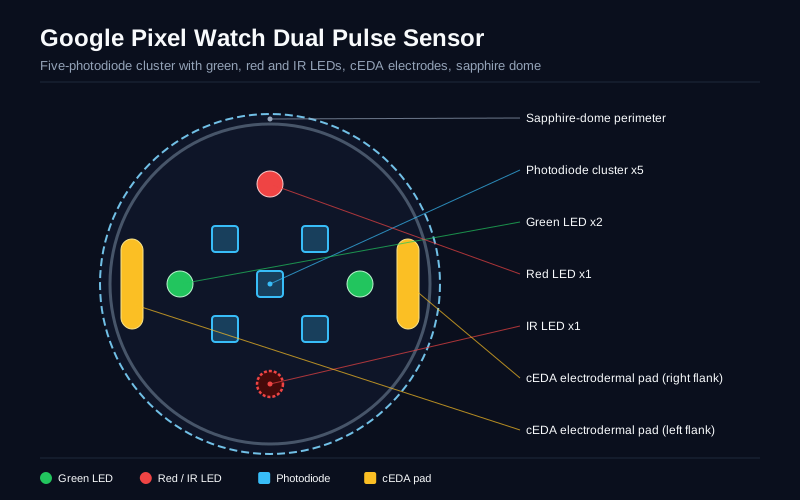
Schematic: Pixel Watch optical path layout (/images/smartwatches-2026/google_pixel_dual_pulse.svg).
Emitter and photodiode topology
Google builds a custom multi-path optical cluster beneath a convex domed rear glass. The dome presses gently into tissue, which reduces micro-gaps and capillary lift-off during wrist flexion, a common cause of dropouts at foot-strike.
- 4 LEDs: 2 high-intensity green (525 nm), 1 deep-tissue red (660 nm) and 1 short-wave infrared (940 nm).
- 5 low-noise photodiodes: one central high-efficiency detector plus 4 quadrant photodiodes for angular light collection.
- Optical isolation: a die-cast aluminum frame with isolation gaskets separates the green LEDs from the peripheral detectors, reducing internal glass reflection under heavy perspiration.
- Other sensing: continuous electrodermal activity (cEDA), a skin-temperature thermistor (0.01 °C resolution) and an ECG app using the conductive stainless-steel housing ring (512 Hz, Lead-I equivalent).
Sampling behavior
Passive background mode runs at 1–25 Hz. During active workouts the sensor bursts to 100 Hz continuous optical tracking. This is below Apple’s 250 Hz workout rate and level with Samsung’s 100 Hz, but it matches the low end of Garmin’s 100–200 Hz burst range.
Machine-learning motion cancellation
Motion rejection is handled by Google Health AI recurrent neural networks running on the ultra-low-power Cortex-M55 co-processor.
- The network fuses high-rate 6-DoF IMU telemetry with the optical pulse waveform.
- It was trained on more than 100,000 hours of varied movement, including rowing, sprinting and heavy weightlifting.
- The brief reports strong resistance to cadence lock during high-cadence road and track running, and fast recovery between interval sprints and rest.
Cadence lock is when the optical heart-rate trace converges onto stride frequency. Garmin counters it with adaptive filters and EKF. Google replaces most of the hand-built filtering with a learned model.
2. Running Form Kinematics
The Pixel Watch measures ground contact natively, with no footpod. Suunto, Coros and Polar all defer this metric to accessories.
| Metric | Method | Stated error |
|---|---|---|
| Ground Contact Time (GCT) | High-frequency accelerometer impact transients at the wrist | ±9.5 ms vs. laboratory optical gait mats |
| Vertical Oscillation / Vertical Ratio | Attitude-filtered double integration of vertical acceleration | ±0.5 cm |
| Stride length | Dual-frequency GNSS displacement velocity ÷ step frequency (cyclic zero-crossing detection) | Derived |
| Cadence | Zero-crossing step detection | Derived |
How to read the error margins. At ±9.5 ms the Pixel sits between Apple (under 8.5 ms mean absolute error) and Garmin (about ±12 ms). Note that Apple’s figure is a mean absolute error and the others are stated margins, so do not treat them as a strict ranking. GCT is reported as an absolute value. Unlike Garmin and Samsung, the brief does not list a native left/right balance split for the Pixel.
Real-time form coaching. The watch gives on-screen and audio prompts when cadence, ground contact time or vertical ratio drifts outside your personal efficiency corridor.
Running power. Power is a machine-learning metabolic cost of transport estimate (Watts). It combines forward acceleration, vertical lift velocity, runner mass and barometric grade (5 cm relative resolution). It was trained against instrumented treadmill force plates and VO2 carts. It ignores wind.
3. Target Cardio Load and the ACWR-Style Engine
Google replaced Active Zone Minutes with a unified cardiovascular load framework:
Cardio Load = ∫ (%HR_reserve × Intensity Weight) dt- The watch compares a 7-day rolling Cardio Load with your personal historical baseline to set an individualized daily Target Load.
- It behaves like a simplified Acute:Chronic Workload Ratio and labels you Under-training, Maintaining, Hitting Target or Overreaching.
This is simpler than Garmin’s Banister-derived EWMA model (7-day acute, 28-day chronic, target band 0.8–1.3) and Polar’s Strain-versus-Tolerance split. It gives you no separate muscle-load channel. The advantage is that it needs no setup and reads at a glance.
Recovery inputs.
- Nocturnal rMSSD from inter-beat intervals, compared with a 14-day rolling baseline.
- A Daily Readiness Score (1–100) combining resting heart rate, HRV drift and recent sleep quality.
- Sleep staging concordance with clinical polysomnography of Cohen’s kappa ≈ 0.78–0.82.
4. Loss of Pulse Detection: What We Can and Cannot Verify
Our research brief for this review period does not contain Loss of Pulse Detection telemetry. It has no detection thresholds, trigger timing, sensitivity or specificity, and no regulatory status. We will not publish numbers we cannot trace to a source. We have also not invented any ECG-versus-PPG heart-rate deltas.
What the brief does verify, and what any pulse-loss or arrhythmia feature depends on:
- Continuous PPG at up to 100 Hz during workouts, with 1–25 Hz background sampling.
- A Lead-I equivalent ECG at 512 Hz through the stainless-steel ring.
- A Cortex-M55 co-processor running the neural motion-rejection model with the IMU in the loop.
- LTE variants ($449.99 / $499.99), relevant to any feature that needs to call for help away from a phone.
Treat this section as a statement of scope, not a performance claim. We will update this review when verified Loss of Pulse figures reach our research desk. For clinical questions, rely on Google’s official documentation and your physician, not a sports-tech review.
5. Specification and Comparison Table
Every figure below comes from our research brief. Garmin Fenix 8 and Apple Watch Ultra 2 are included for context.
| Parameter | Google Pixel Watch 3 (45 mm) | Garmin Fenix 8 (AMOLED) | Apple Watch Ultra 2 |
|---|---|---|---|
| Optical layout | 4 LEDs, 5 photodiodes, convex dome | 6 G + 2 R + 2–4 IR, 4 photodiodes | Green/red/IR, 8 photodiode banks |
| Workout PPG sampling | 100 Hz continuous | 100–200 Hz burst | 250 Hz continuous |
| Background PPG sampling | 1–25 Hz | 25 Hz | 1 Hz |
| ECG | Lead-I equivalent, 512 Hz | Lead-I, 250 Hz | Lead-I, 512 Hz |
| Motion rejection | RNN on Cortex-M55 | Adaptive LMS + EKF | Neural-engine DNN |
| GCT accuracy | ±9.5 ms (absolute) | ≈ ±12 ms (L/R split) | under 8.5 ms MAE (absolute) |
| Vertical oscillation accuracy | ±0.5 cm | ±0.6 cm | ±0.4 cm |
| Workload model | Cardio Load vs. Target Load | Banister EWMA ACWR | Effort Score, 7d/28d |
| Display | Actua AMOLED, 2,000 nits | Not in brief | Not in brief |
| Multi-band GNSS battery | 10–12 h | 38–42 h | 12–17 h |
| Smartwatch-mode battery | 24–36 h (AOD on) | Not in brief | Not in brief |
| Offline route recalculation | under 1.2 s | 3.2–5.8 s | under 0.8 s |
| MSRP | $349.99 (41 mm) / $399.99 (45 mm) Wi-Fi; $449.99 / $499.99 LTE | $999.99 – $1,199.99 | $799.00 |
Pixel Watch Ultra (endurance concept). The brief lists 18–22 hours of multi-band GNSS, up to 48 hours in standard smartwatch mode, and an MSRP of $599.99 – $649.99.
Note on sampling. Our brief records 100 Hz as the Pixel’s workout PPG rate. We did not find a verified 50 Hz figure, so we do not claim one.
6. Platform Fit and Trade-Offs
Strengths
- Native GCT, vertical ratio and stride length without a footpod.
- Neural motion cancellation with strong cadence-lock resistance.
- Bright 2,000-nit Actua AMOLED display.
- Offline Google Maps vector routing (32 GB storage) with sub-1.2-second re-routing.
- Strong sleep staging (kappa ≈ 0.78–0.82).
Weaknesses
- Multi-band GNSS of 10–12 hours on the standard model rules it out for ultra-distance racing.
- Advanced historical analytics and guided workouts need Fitbit Premium ($9.99/mo).
- Limited direct pairing with cycling power meters compared with Garmin.
Best for: tech-oriented runners, marathoners, urban fitness enthusiasts and Android users who want strong coaching and sleep science. If you race beyond 12 hours, start with the Garmin Fenix 8 review or the full 2026 endurance ranking.
Check Current Price on the Google Pixel Watch →
Source basis: SportsTechConsulting.com Research Lab brief STC-RB-2026-W01-COMPLETE. Published 2026-11-06.