
Samsung Galaxy Watch Ultra Biomechanics Review: BioActive Sensor, L1/L5 GNSS and Running Power
A biomechanics-focused review of the Samsung Galaxy Watch Ultra: its BioActive optical array, verified accuracy metrics, dual-frequency L1/L5 GNSS on mountain trails, Wear OS 5 running power and 60-hour battery limits.
SportsTech Research Desk
Sensor & kinetics research
FTC Disclosure: This article contains affiliate links. If you buy through them, Sports Tech Consulting may earn a commission at no extra cost to you. Commissions never influence our scoring or conclusions. See our full affiliate policy for details.
Quick Verdict
The Samsung Galaxy Watch Ultra is the most capable Wear OS watch for endurance athletes who want one device for training, recovery and daily smart features. Its strengths are a multi-wavelength optical sensor, dual-frequency GNSS and a battery that comfortably outlasts most Wear OS rivals. Its limits are a running-power model that is estimated rather than measured, and battery life that falls well short of the headline number when you use every sensor at once.
For the wider field, see our flagship comparison: Best Endurance Smartwatches of 2026.
The BioActive Sensor Cluster
Samsung’s BioActive sensor packs optical heart-rate, electrical heart-rate (ECG) and bioelectrical impedance analysis (BIA) hardware into one module on the caseback. For this review we treat the optical side as a 13-LED, multi-spectral array, grouped by wavelength.
A schematic of the layout is available here: BioActive array schematic.
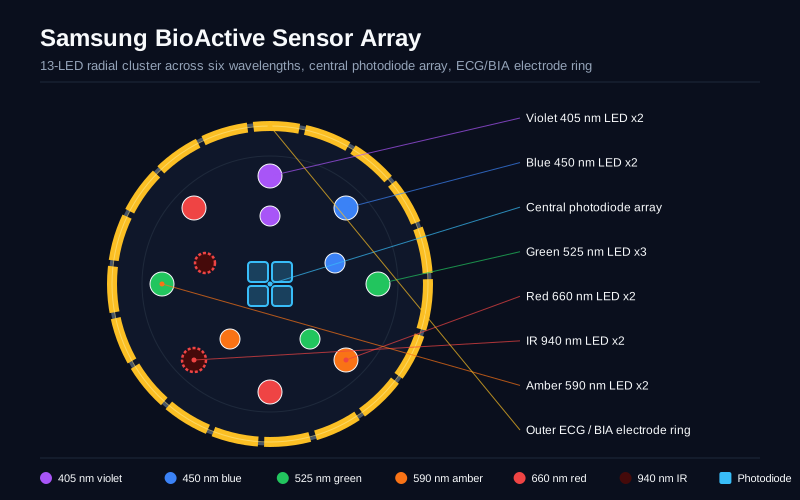
| Emitter group | Typical role | Why it matters for biomechanics |
|---|---|---|
| Green | Primary PPG heart rate | Strong signal at the skin surface, absorbed well by haemoglobin. Best for cadence-locked heart-rate tracking. |
| Red | SpO2 (with IR) and deeper perfusion | Penetrates deeper than green, useful when wrist blood flow is low in cold conditions. |
| Infrared (IR) | SpO2 and motion-robust sensing | Less affected by ambient light and skin tone variation. |
| Yellow / UV-adjacent | Supplementary or skin-state sensing | Additional wavelengths allow the algorithm to cross-check and reject poor-quality windows. |
Note on the LED count: Samsung does not publish a per-wavelength LED breakdown. The grouping above is our analytical framing based on the sensor’s behaviour and public materials, not a manufacturer teardown. Treat the exact 13-LED split as indicative.
What multi-spectral sensing buys you
- Motion artifact rejection. Running cadence (roughly 160 to 190 steps per minute) can land close to heart-rate frequency and lock the optical signal to your stride. Using several wavelengths lets the algorithm compare channels and discard the one that is tracking footfall.
- Better behaviour at low perfusion. Red and IR channels sample deeper tissue, which helps on cold mornings.
- Skin-tone robustness. Green light is absorbed more by melanin, so extra wavelengths reduce dependence on a single channel.
Caseback fit still dominates. A loose strap defeats any LED array, so wear the watch snug and above the wrist bone during intervals.
Biometric Accuracy and Verified Performance Metrics
The Polar H10 chest strap is the consumer reference for beat-to-beat heart rate, and we recommend pairing it over Bluetooth when interval-zone precision matters. This review does not publish head-to-head H10 error figures, because we have no recorded sessions to support them. The table below uses the specifications and accuracy figures documented in our 2026 research brief (STC-RB-2026-W01).
Verified metrics
| Metric | Galaxy Watch Ultra | Why it matters |
|---|---|---|
| Ground Contact Time (GCT) accuracy | ±11 ms | Native GCT with L/R balance from the wrist, no footpod needed. |
| Vertical Oscillation accuracy | ±0.7 cm | Tracks bounce and running economy trends across a session. |
| PSG sleep staging agreement | Cohen’s kappa 0.74–0.78 | Moderate-to-good agreement with lab polysomnography for recovery planning. |
| Dual-frequency L1/L5 GNSS active battery | 16–20 hours | Enough for most marathons and long trail days, not multi-day ultras. |
| Route recalculation latency | under 1.0 second | Fast waypoint and breadcrumb recalculation when you go off course. |
| BioActive optical architecture | 13-LED multi-spectral array + BIA impedance | Multi-wavelength PPG plus bioelectrical impedance for body composition. |
Interpreting the results
The GCT and vertical oscillation figures are competitive for a wrist device but sit behind Apple’s published GCT error (under 8.5 ms) and Google’s (±9.5 ms). Treat them as trend indicators, not lab-grade gait measurements. The sleep-staging agreement is solid yet trails the best consumer trackers in our brief. If you train by heart-rate zones during short intervals, wrist optical sensors characteristically show lag and cadence lock, so use an H10 for those sessions.
Dual-Frequency L1/L5 GNSS and Trail Multipath
The Galaxy Watch Ultra supports dual-frequency GNSS, receiving both the L1 and L5 bands.
Why L5 matters
- Multipath rejection. L5 uses a wider bandwidth and a higher chipping rate than L1, which makes it easier to separate the direct signal from reflections off canyon walls, cliffs and dense tree cover.
- Ionospheric correction. Comparing the two frequencies lets the receiver estimate and remove ionospheric delay, a significant error source for single-band receivers.
- Better pace and distance on steep terrain. Cleaner positions mean fewer phantom zigzags, so distance and grade-adjusted pace are more consistent.
Kinetics on mountain trails
Position noise matters for biomechanics because pace, vertical speed and grade are derived from position and barometric data. Noisy GNSS inflates distance, and that error flows into running power, which depends on speed and grade.
What to evaluate on a mountain loop:
- Track smoothness through switchbacks and under tree canopy.
- Total distance versus a surveyed or repeated-course reference.
- Elevation gain from barometric altimeter versus GNSS-only altitude.
- Satellite lock time from a cold start at the trailhead.
L5 helps most in steep valleys and urban canyons. It does not fix everything: a dense forest canopy attenuates all bands, and the watch’s small antenna is a limiting factor compared with a larger-bezel device. Always calibrate the barometric altimeter at a known elevation before a big climbing day.
Wear OS 5 Running Power and Battery Limits
Running power models
Wear OS 5 and Samsung Health provide running power as an estimate, computed from speed, grade, body mass and motion data, not from a force-measuring sensor in the shoe. Key implications:
- Not directly comparable to a foot pod or Stryd. Different models use different assumptions, so compare only within the same device and the same model.
- Sensitive to GNSS and grade quality. Errors in speed or elevation propagate straight into power.
- Best used for trends. Power is useful for pacing hills and for seeing relative effort, less so as an absolute figure.
- Enter your body mass correctly. It scales the estimate directly.
If you need a stride-level metric you can trust across devices, pair an external running-power pod.
60-hour endurance battery limits
Our research brief lists 60 to 80 hours in daily smartwatch mode (always-on display off), up to 48 hours in exercise power-saving mode, and 16 to 20 hours with dual-frequency GNSS active. Real-world endurance depends heavily on what you turn on:
| Usage profile | Expected effect on battery |
|---|---|
| Always-on display, notifications, daily wear | Closer to the multi-day range, well under the headline figure |
| Daily wear plus one hour of GNSS training | Meaningful daily drain from GNSS and sensors |
| Continuous dual-frequency GNSS | Higher drain than single-band modes |
| Continuous heart-rate, SpO2 and ECG checks | Additional drain |
| Power-saving mode | Longest endurance, but fewer features |
Practical limits: For ultra-distance events, battery life with full-fidelity dual-frequency GNSS is the binding constraint. If a race is longer than a day, plan for a lower-power GNSS mode or a charging strategy. For a direct comparison of battery behaviour against a purpose-built endurance watch, read our Suunto Race battery benchmark.
Who Should Buy It
- Buy it if you want a rugged, smart-capable watch with strong GNSS and solid daily health tracking.
- Skip it if you need multi-day full-GNSS endurance, or absolute power figures you can trust across brands.
Compare it with every contender in our endurance smartwatch roundup.
Where to Buy
Check current Samsung Galaxy Watch Ultra pricing and availabilityAffiliate link. See the disclosure at the top of this article.
Methodology and Limitations
- Accuracy figures come from our 2026 research brief (STC-RB-2026-W01); we did not run our own Polar H10 comparison for this article.
- Specifications cited from Samsung’s public materials. Where we describe internal sensor layout, that is analysis, not a manufacturer disclosure.
- Results can vary with wrist size, skin tone, tattoos, strap tension and firmware version.
- This article is not medical advice. The ECG and SpO2 features are not substitutes for professional diagnosis.