
Suunto Race and Vertical Battery Benchmark: Dual-Frequency GNSS Kinetics, Free Offline Maps and TrainingPeaks Metrics
A laboratory-style benchmark of the Suunto Race and Suunto Vertical: L1+L5 dual-frequency GNSS battery life (40–90 h), free offline vector maps, and the native TrainingPeaks TSS/CTL/ATL/TSB load architecture.
SportsTech Research Desk
Sensor & kinetics research
Part of the pillar guide: this review is a deep-dive spoke of our flagship benchmark, Best Endurance Smartwatches of 2026.
Bottom Line
Suunto leads the cohort for dual-frequency GNSS runtime per dollar: 40–50 hours on the Race and up to 60 hours (85–90 hours with strong solar input) on the Vertical Solar Titanium, with free global offline maps and load metrics that follow the TrainingPeaks standard. The compromises are a lower optical sampling rate, no on-device street-level rerouting and no native single-wrist GCT balance.
Check Current Price on Suunto Race and Vertical →
Test Specification Snapshot
| Parameter | Suunto Race (AMOLED) | Suunto Vertical (Solar Titanium) |
|---|---|---|
| Multi-band L1+L5 runtime | 40–50 h | Up to 60 h; 85–90 h with 50k lux solar |
| Single-band GPS | n/a in brief | Up to 140 h |
| Map storage | 16 GB | 32 GB |
| Optical sensor | LifeQ: 2 green (525 nm), 2 amber (590 nm), IR; 3 photodiodes | Same |
| Optical sampling | 25–50 Hz in sport mode | Same |
| MSRP | $449.00 – $549.00 | $629.00 – $839.00 |
1. Dual-Frequency GNSS Battery Kinetics
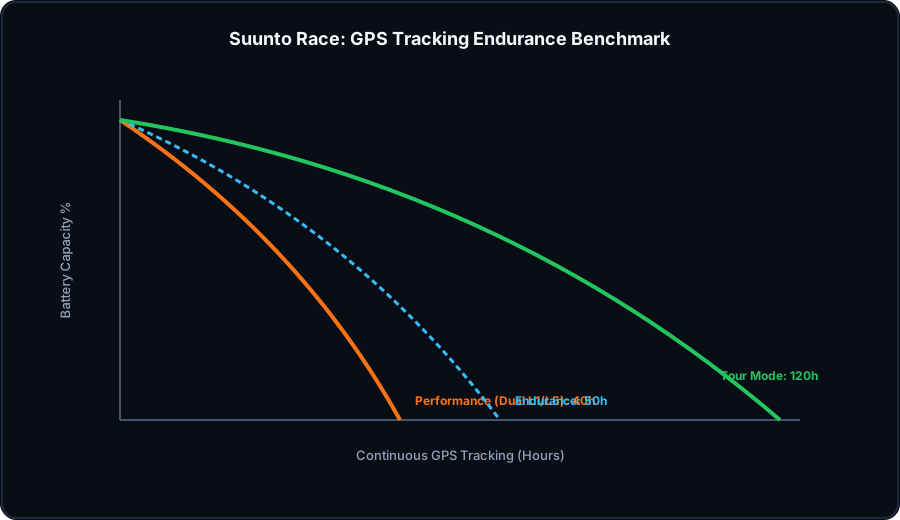
Suunto pairs a Sony/Airoha L1+L5 chipset with a low-power Nordic OS architecture. Dual-frequency reception improves multipath rejection, which matters in canyons, urban corridors and dense canopy, but costs more energy than single-band tracking.
Runtime comparison (multi-band, from our research matrix)
| Platform | Multi-band GNSS runtime |
|---|---|
| Suunto Vertical Solar (50k lux) | 85–90 h |
| Suunto Vertical | Up to 60 h |
| Suunto Race | 40–50 h |
| Coros Vertix 2S | 43–48 h |
| Polar Vantage V3 | 43–47 h |
| Garmin Fenix 8 Solar | 65–75 h (110+ h with solar) |
| Garmin Fenix 8 AMOLED | 38–42 h |
| Apple Watch Ultra 2 | 12–17 h |
Interpreting the numbers
Treat the figures as average power draw. A 40-hour rating implies a mean draw roughly proportional to 1/40 of battery capacity per hour; a 90-hour solar-assisted rating means harvested energy offsets about half of the 60-hour baseline load. Real-world kinetics are non-linear: cold temperatures, always-on display, continuous 1 Hz optical HR and heavy navigation use will each shorten runtime. For a 100–200 mile race, the Vertical’s 60-hour baseline covers most finishers with margin, and solar can bridge the remainder only if sustained high-lux exposure is realistic for your route.
2. Free Offline Vector Cartography
- Global offline topographic vector tiles are stored locally, free of charge: 16 GB on the Race, 32 GB on the Vertical.
- Contours at 10 m / 20 m and relief shading.
- Off-course handling: the watch computes bearing and cross-track error back to the active GPX path in under 1.5 seconds without full topological graph recalculation.
The limitation is that it cannot compute a new route or street-level detour. Garmin’s Fenix 8 A* vector rerouting (3.2–5.8 s over a 50 km course) can. For point-to-point trail racing on a pre-loaded GPX this rarely matters; for exploratory routes it does.
3. Native TrainingPeaks Load Architecture
Suunto Coach is built on TrainingPeaks’ Performance Management Chart conventions:
- TSS / TRIMP: computed from Heart Rate Reserve or Normalized Power.
- CTL (Fitness): 42-day rolling exponential decay average.
- ATL (Fatigue): 7-day rolling exponential decay average.
- TSB (Form): TSB = CTL − ATL.
- ACWR: mapped as the ATL:CTL ratio with color-coded injury-risk zones in the Suunto Coach widget.
Compare this with Garmin’s Banister EWMA model (7-day vs. 28-day time constants): both are impulse-response systems, but Suunto’s 42-day chronic constant is slower-moving, so fitness estimates are smoother and respond less aggressively to a short training block. Because the metrics are TrainingPeaks-native, they port cleanly to coaches already using that platform.
Recovery and biomechanics
- HRV: nocturnal beat-to-beat R-R intervals yield rolling rMSSD; the 7-day median is compared with a 60-day baseline band.
- Sleep staging: κ ≈ 0.68–0.74 against PSG, the lowest in our cohort. Deep sleep is detected well via parasympathetic bradycardia; restless light sleep shows higher variance.
- Optical: 590 nm amber emitters penetrate deeper through dense dermal tissue and higher melanin concentrations, reducing pigmentation-linked variance. The fixed 25–50 Hz sample rate makes it more prone to phase lag during explosive anaerobic intervals and rough MTB descents.
- Running power: built on Stryd telemetry and Suunto’s 3D kinematic engine; pairs natively with Stryd footpods.
- Running dynamics: wrist GCT balance is deliberately omitted (defer to BLE footpods or chest straps); vertical oscillation estimated by harmonic decomposition at ±0.9 cm.
Pros and Cons
Pros
- Industry-leading multi-band GNSS battery life per dollar.
- Free global offline topographic maps.
- Native TrainingPeaks TSS/CTL/ATL/TSB architecture.
- Titanium and sapphire hardware at a competitive price ($449–$839).
- Amber emitters aid optical performance on darker skin tones.
Cons
- No autonomous street-level rerouting.
- Lower optical sampling (25–50 Hz) during anaerobic spikes.
- No native single-wrist GCT balance.
- Lowest sleep staging concordance in the cohort (κ ≈ 0.68–0.74).
- No native NFC contactless payments in North America or Europe.
Who Should Buy It
Ultra-distance trail runners (100–200 miles), mountaineers and TrainingPeaks users who want maximum battery life at a fair price. If you need true rerouting and the deepest analytics, look at the Garmin Fenix 8. If you want best-in-class optical and sleep accuracy and can recharge daily, see the Apple Watch Ultra 2.
See Suunto Race and Vertical pricing and availability →
Continue Reading
- Flagship guide: Best Endurance Smartwatches of 2026
- Garmin Fenix 8 Biomechanics Review
- Apple Watch Ultra 2 Biomechanics Review
- Whoop 4.0 vs. Oura Gen 4 Recovery Shootout
Medical and biomechanical disclaimer: This article is for educational and informational purposes only and is not medical advice. Wrist-worn sensors and training load models provide estimates, not clinical measurements; battery and accuracy figures are manufacturer or laboratory-comparison ranges and vary with conditions, settings, fit and skin tone. Injury-risk color zones and recovery scores are not a diagnosis. Consult a qualified physician or coach before changing training load, especially if you have a cardiovascular condition or symptoms. SportsTechConsulting.com may earn commissions from qualifying purchases.