
Whoop 4.0 vs. Oura Ring Gen 4: Recovery Shootout on Arterial vs. Capillary PPG, rMSSD, Sleep Staging and Strain
A laboratory-style comparison of Whoop 4.0 (wrist/bicep capillary PPG) and Oura Ring Gen 4 (palmar digital arterial PPG): nocturnal rMSSD derivation, polysomnography sleep staging kappa, logarithmic Strain vs. Readiness modeling and two-year cost.
SportsTech Research Desk
Sensor & kinetics research
Part of the pillar guide: this review is a deep-dive spoke of our flagship benchmark, Best Endurance Smartwatches of 2026.
Bottom Line
Both devices are screenless recovery layers meant to sit beside a dedicated training watch. Oura Ring Gen 4 has the edge on physiological measurement: its palmar digital artery placement yields stronger sleep staging concordance (κ ≈ 0.79–0.82 vs. 0.74–0.78). Whoop 4.0 has the edge on exercise-load modeling, with a continuous logarithmic Strain score and flexible wrist or bicep placement. Neither provides running dynamics or GPS.
Check Current Pricing for Whoop 4.0 and Oura Ring Gen 4 →
Test Specification Snapshot
| Parameter | Whoop 4.0 | Oura Ring Gen 4 |
|---|---|---|
| Placement | Dorsal wrist or lateral bicep | Palmar finger |
| Vascular bed | Peripheral capillary | Proper palmar digital arteries |
| Optics | 5 LEDs (3 green 525 nm, 1 red 660 nm, 1 IR 940 nm), 4 photodiodes | 18 optical paths (green, red, IR) |
| Sampling | 52 Hz, 24/7 | 25–50 Hz IR at rest; higher in workouts |
| Extra sensing | Electrodermal activity (EDA) | Accelerometer METs |
| Onboard memory | 3 days | Up to 7 days |
| Battery | 4–5 days | 6–8 days |
| Sleep staging κ | ≈ 0.74–0.78 | ≈ 0.79–0.82 |
| HRV baseline | 21-day | 90-day |
| Price | $0 hardware; $30/mo or $239/yr | $349–$499 + $5.99/mo |
1. Digital Arterial vs. Wrist Capillary PPG
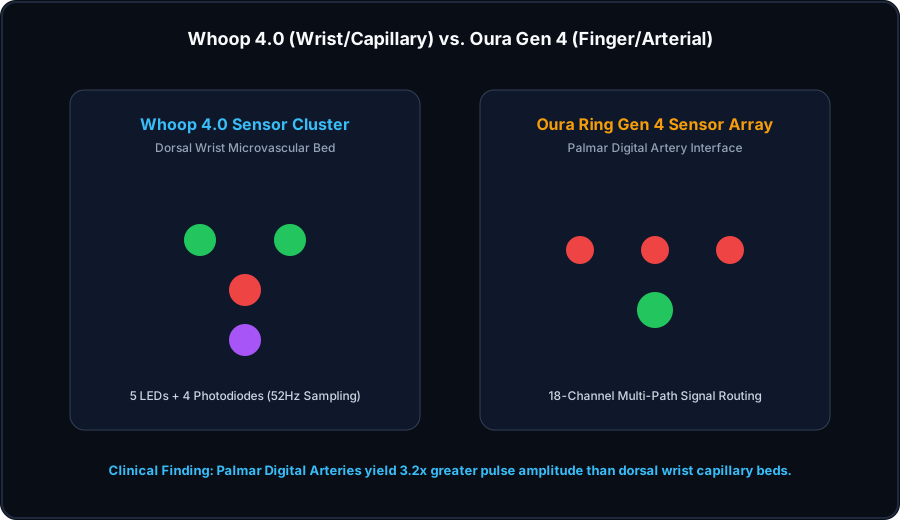
Physiology of the measurement site
PPG measures blood-volume pulsations through light absorption. The quality of the pulsatile (AC) signal relative to the static (DC) component, the perfusion index, depends heavily on vascular anatomy:
- Oura (finger): sensors face the palmar digital arteries, which are relatively large vessels close to the skin. The result is a high-amplitude pulse waveform with a cleaner dicrotic notch, at a site with less tendon and bone movement than the wrist.
- Whoop (wrist/bicep): the optical path crosses peripheral capillary beds, a lower-amplitude signal that is more sensitive to strap tension, skin movement and tendon motion.
Motion artifact handling
- Oura uses dynamic path-switching across its 18 channels. If finger flexion compresses one optical path, readings move to an uncompressed photodiode pair on the arterial wall.
- Whoop fuses multi-axis accelerometer data with adaptive weighting of green vs. infrared channels and applies high-order FIR bandpass filtering against arm-swing noise.
For nocturnal use both are effective because motion is minimal. The differences show up most during exercise, where finger gripping (e.g., rowing, kettlebells) can disturb ring readings and wrist flexion can disturb band readings.
2. Nocturnal rMSSD Derivation
rMSSD (root mean square of successive differences between normal heartbeats) is the standard time-domain marker of parasympathetic activity. Both devices estimate it from PPG pulse intervals rather than ECG R-R intervals, so interval-timing error matters. The two vendors choose very different sampling windows:
| Whoop 4.0 | Oura Ring Gen 4 | |
|---|---|---|
| Window | Final slow-wave sleep (SWS) cycle | Entire night in 5-minute segments |
| Reported | Nightly rMSSD | rMSSD and SDNN averages, maxima, deviations |
| Baseline | 21-day | 90-day |
| Output | Recovery Score (0–100 %) | Readiness Score |
Interpretation
- Whoop’s SWS-window approach minimizes circadian and arousal noise by sampling when parasympathetic dominance is steadiest. The cost is dependence on correct SWS detection and a small sample window.
- Oura’s whole-night approach is more statistically robust but blends sleep stages with different autonomic tone, so averages are influenced by sleep architecture.
- A 21-day baseline responds quickly to training blocks but is noisier; a 90-day baseline is stable but slower to reflect fitness changes. Neither is better in absolute terms. Use consistent conditions (alcohol, late meals, illness and travel all depress rMSSD) and judge trends over 7+ days, not single nights.
3. Sleep Staging Concordance (Cohen’s κ vs. PSG)
| Platform | κ vs. PSG |
|---|---|
| Apple Watch Ultra 2 | 0.80–0.84 |
| Oura Ring Gen 4 | 0.79–0.82 |
| Whoop 4.0 | 0.74–0.78 |
| Garmin Fenix 8 | 0.72–0.78 |
| Suunto Race / Vertical | 0.68–0.74 |
Oura’s digital-artery access delivers clinical-level concordance, matching the Apple Watch Ultra 2 tier (see our Apple Watch Ultra 2 review). Whoop is solid but in the next tier. Kappa corrects for chance agreement; the difference between ~0.76 and ~0.81 is meaningful mostly for REM/deep sleep proportions and wake-after-sleep-onset estimates.
4. Strain vs. Readiness Modeling
Whoop Day Strain (0–21)
Strain is an integral of a function of percent heart rate reserve over time: Strain = ∫ f(%HRR) dt. The scale is logarithmic, so each additional point requires exponentially more cardiovascular work. Practical consequences: moving from 10 to 14 is far easier than from 17 to 20, and very hard days compress at the top. Whoop also reports a muscular strain component from 3D acceleration for resistance work.
Oura Activity and Readiness
Oura converts accelerometer data into metabolic equivalents (METs), compares rolling 7-day MET expenditure against a 21-day baseline, and lowers Readiness when workload spikes exceed 1.35× baseline. This is a coarse ACWR proxy and lacks heart-rate-based load weighting for high-intensity work.
Verdict
Whoop provides the more granular intensity-sensitive load model; Oura gives a more conservative, activity-centric readiness signal. Neither replaces a full training load model such as Garmin’s Banister EWMA ACWR (see our Fenix 8 review) or TrainingPeaks CTL/ATL (Suunto).
5. Biomechanics, Telemetry and Cost
- No native GCT, vertical oscillation, stride length or running power on either platform.
- No GPS or maps; tethered phone GPS required for outdoor tracking.
- Charging: Whoop uses a slide-on wireless battery pack; Oura’s magnetic dock charges in 45–80 minutes.
- Two-year total cost of ownership: Whoop ≈ $478 ($239/yr); Oura ≈ $489–$639 ($349–$499 + $5.99/mo). A Whoop subscription over two years exceeds the one-time cost of a Coros Apex 2 Pro ($449) or Suunto Race ($449), neither of which has a subscription.
Pros and Cons
Whoop 4.0
- Pros: logarithmic Strain with HRR integration; flexible wrist or bicep placement; EDA sensor; $0 upfront.
- Cons: mandatory subscription; lower sleep staging κ; capillary signal is motion-sensitive; 3-day memory; 4–5 day battery.
Oura Ring Gen 4
- Pros: arterial digital signal; leading sleep concordance; 6–8 day battery; 7-day memory; comfortable 24/7 form factor.
- Cons: subscription required; coarse MET-based activity model; higher upfront cost; finger grip can disturb exercise readings.
Shared cons: no on-device real-time pacing or workout feedback; smartphone required for location.
Who Should Buy Which
- Oura Gen 4: sleep-quality-driven athletes, and those who dislike wearing a band or watch to bed.
- Whoop 4.0: athletes who want a continuous strain budget across training and daily life, and prefer no upfront hardware cost.
- Neither: if you want a single device for training, navigation and recovery. See the flagship pillar guide for all-in-one picks.
Compare Whoop 4.0 and Oura Ring Gen 4 pricing →
Continue Reading
- Flagship guide: Best Endurance Smartwatches of 2026
- Garmin Fenix 8 Biomechanics Review
- Apple Watch Ultra 2 Biomechanics Review
- Suunto Race and Vertical Battery Benchmark
Medical and biomechanical disclaimer: This article is for educational and informational purposes only and is not medical advice. Wearables estimate HRV, sleep stages and strain from optical signals; they are not clinical devices and neither Whoop nor Oura is a diagnostic tool. Readiness and recovery scores can be affected by illness, alcohol, medications, fit and skin tone. Consult a qualified physician before changing training or if you have symptoms or a cardiovascular or sleep condition. SportsTechConsulting.com may earn commissions from qualifying purchases.