
Cycling Rearview Radar: 24 GHz vs. 60 GHz — FMCW Physics, Zero-Doppler Dropout & a Six-Unit Hardware Review
Engineering and biomechanics review of 24 GHz and 60 GHz cycling rearview radars: FMCW range resolution, beam geometry on descents, matched-speed dropout, head-unit telemetry, and six units compared.
SportTechConsulting Research Lab
Sensor Architecture & Biomechanics Research
Bottom line: The 60 GHz Garmin Varia RearVue 820 is a different class of sensor from the five 24 GHz units here. Its much wider sweep bandwidth is what makes vehicle-size and lane-change telemetry physically possible. But that extra data only appears on a compatible Garmin Edge or the Varia app. If you ride a third-party head unit, or you mainly need “car approaching” awareness, a 24 GHz unit at a fraction of the price covers the core safety job.
A rearview radar does one thing a mirror cannot: it tells you about a vehicle you are not looking at, before the driver has decided what to do. This review covers six units: the Garmin Varia RearVue 820 (60 GHz), and five 24 GHz units: Wahoo TRACKR RADAR, Garmin Varia RTL515, Bryton Gardia R300L, Magene L508 and COOSPO TR70.
Methodology. This is a first-principles RF analysis by SportTechConsulting Research Lab, built on manufacturer specifications, published independent road tests and peer-reviewed literature. SportsTech Consulting did no in-house RF bench testing. Where we reason beyond published data, we label it as inference. Independent runtimes cited below come from third-party road tests (Cyclists Hub, GPLama) and not from our own lab.
If you are building out a cycling data stack, our Favero Assioma PRO RS-2 vs. Duo review covers the power side, and our best endurance smartwatches of 2026 guide covers the wrist.
1. Why Overtaking Risk Is Worth an Active Sensor
Chao et al. (2025) reanalysed UK crash data on overtaking, rear-end and door crashes involving bicycles. The paper reports adjusted odds ratios (AOR) for several risk factors. Three are directly relevant here: an overtaking crash involving a heavy goods vehicle (HGV) carries an AOR of 1.30; the joint HGV and rural-road effect reaches an AOR of 2.62; and rear-end crashes in unlit darkness carry an AOR of 1.49. DOI: 10.1371/journal.pone.0315692
Those numbers describe elevated odds, not the effect of any product. They tell us where a rear sensor could matter most: heavy vehicles, rural roads and darkness.
Wanvik (2009) examined road lighting and crash outcomes, which is the background for why darkness is a distinct hazard category for vulnerable road users. DOI: 10.1016/j.aap.2008.10.003
Farah et al. (2019, pp. 226–239) studied how drivers overtake cyclists, and why an oncoming vehicle can make a driver trail a cyclist and then pass late. That behaviour matters in section 3, because a trailing vehicle at nearly your speed is the scenario Doppler radar handles worst. DOI: 10.1016/j.trf.2019.04.026
2. FMCW Physics: What 24 GHz and 60 GHz Actually Change
All six units use frequency-modulated continuous-wave (FMCW) radar. The transmitter sweeps its carrier frequency across a bandwidth B during each chirp. The receiver mixes the echo with the outgoing signal, so a target at range R produces a low-frequency beat tone proportional to R. Hasch et al. (2012) is the standard reference for this architecture at millimetre-wave frequencies. DOI: 10.1109/TMTT.2011.2178427 Patole et al. (2017) reviews the range-Doppler processing chain. DOI: 10.1109/MSP.2016.2628914
Range resolution depends on bandwidth, not carrier frequency
The minimum separation at which two targets resolve as two peaks is:
Range resolution = c / (2 × B)
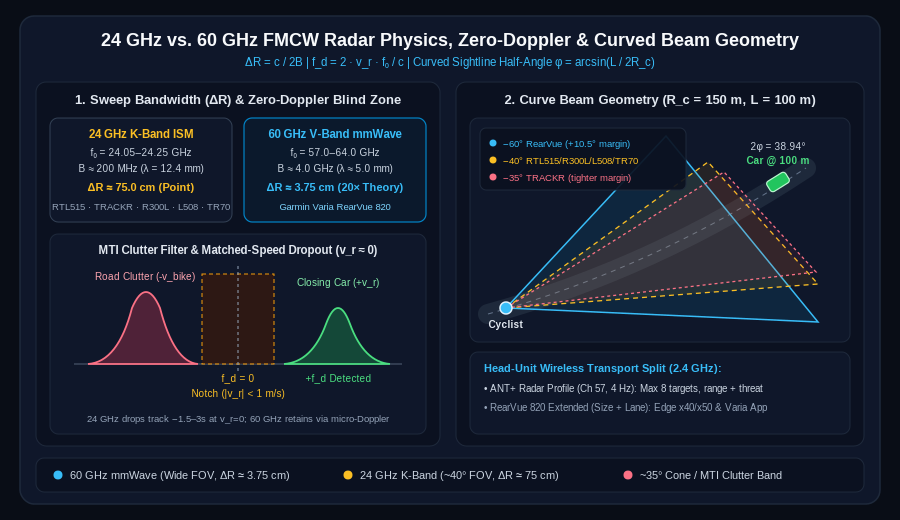
The 24 GHz ISM allocation near 24.05–24.25 GHz offers about 200 MHz, which gives roughly 75 cm resolution. A 60 GHz-class system that sweeps several GHz can reach the single-digit centimetre range; a 4 GHz sweep, for example, gives 3.75 cm. We do not have a manufacturer-published sweep figure for the RearVue 820, so treat 3.75 cm as an illustration of what the band allows, not a measured spec.
The practical consequence, which Villeval et al. (2014, pp. 1237–1240) examined for 24 GHz automotive radar, is that a 200 MHz sweep sees a vehicle as a lump with a speed and a rough strength, and little structure. DOI: 10.1109/radar.2014.6875787 Classifying vehicle size needs enough range cells across a vehicle to extract shape and scatterer spread. Lee et al. (2017, Vol. 11(10):1589–1596) demonstrate feature-based classification of road users from a high-bandwidth automotive FMCW radar. DOI: 10.1049/iet-rsn.2017.0126 That work is on a 77 GHz automotive sensor, and applying it to the RearVue 820 is our inference, not a Garmin statement.
Wavelength, Doppler and antennas
Doppler shift is 2 × v / λ. At about 24.1 GHz the wavelength is roughly 12.4 mm, giving about 161 Hz per m/s of closing speed. At about 60 GHz the wavelength is near 5 mm, giving about 400 Hz per m/s, which is roughly 2.5 times more. A shorter wavelength also lets a multi-element antenna array fit in a taillight-sized housing, which is what enables angle-of-arrival estimation and lane-level position. Patole et al. (2017) cover how transmit and receive antennas combine into a virtual array. We have no verified antenna-count figure for the RearVue 820, so we do not state one.
Wet radomes
At millimetre-wave frequencies, a film of water on a plastic housing absorbs and reflects far more energy than at 24 GHz. Chen et al. (2017, pp. 139–142) studied water-covered radomes on automotive radar. DOI: 10.23919/eurad.2017.8249166 Their work is at 77 GHz, so for a 60 GHz seatpost unit in road spray the conclusion is directional: expect a bigger wet-weather penalty at 60 GHz than at 24 GHz, and treat any specific dB figure as unverified for these products.
3. The Zero-Doppler Dropout
Radar measures relative radial speed. Stationary roadside objects look like they approach at your own riding speed, so firmware filters out returns near zero relative speed to avoid tracking guardrails and asphalt. A common design choice is a notch at under roughly 1 m/s of relative speed; the exact threshold is not published for these products.
The failure case is a driver who slows to your speed. If both of you travel at 25 km/h, relative speed is near zero, and the target can sit inside that notch. Track coasting then times out and the dot disappears while the vehicle is still close behind you. Farah et al. (2019) is why this is not a contrived case: drivers do trail cyclists while waiting for a gap.
Published testing of the COOSPO TR70 includes this kind of caveat. GPLama reported cases where the radar cleared early on a vehicle that was still behind the rider. Treat any rearview radar as an aid for approaching traffic, and not as proof that the road behind you is empty.
Our inference is that a 60 GHz unit with fine range resolution has an easier time keeping a slow, close vehicle as a distinct target. A short wavelength also makes small moving parts produce a measurable Doppler spread. We have not seen independent test data confirming this on the RearVue 820, so we present it as physics reasoning, not a verified result.
Beam geometry on a descent
Consider a sweeping bend of 150 m radius, with a vehicle 100 m behind along the line of sight. The vehicle sits roughly 19.5 degrees off your rear axis, so a radar needs about 39 degrees of total horizontal field of view to hold it. A narrower beam, such as about 35 degrees, acquires that vehicle later, and a beam near 40 degrees only just holds it. A 60-degree-class beam has margin. These beam angles are approximate, drawn from our research dossier rather than a verified manufacturer table, so confirm them against current datasheets before relying on the numbers. The geometry itself is simple trigonometry and holds for any beam.
4. Telemetry: What You See Depends on the Head Unit
All six units broadcast the open ANT+ bicycle radar profile, so any compatible head unit shows approaching-vehicle dots and alerts. The RearVue 820 adds richer data, and Garmin’s own telemetry has a clear boundary:
- Extended vehicle-size and lane-change telemetry requires a compatible Garmin Edge (for example the x40 and x50 series) or the Varia app.
- Third-party head units fall back to standard ANT+ radar threat dots.
That caveat is the single biggest purchase-decision factor in this review. The RearVue 820’s advantage is real but ecosystem-gated.
5. Spec Matrix
| Unit | RF band | Weight | Size (mm) | Max light output | Claimed battery | Independent battery | MSRP (street) |
|---|---|---|---|---|---|---|---|
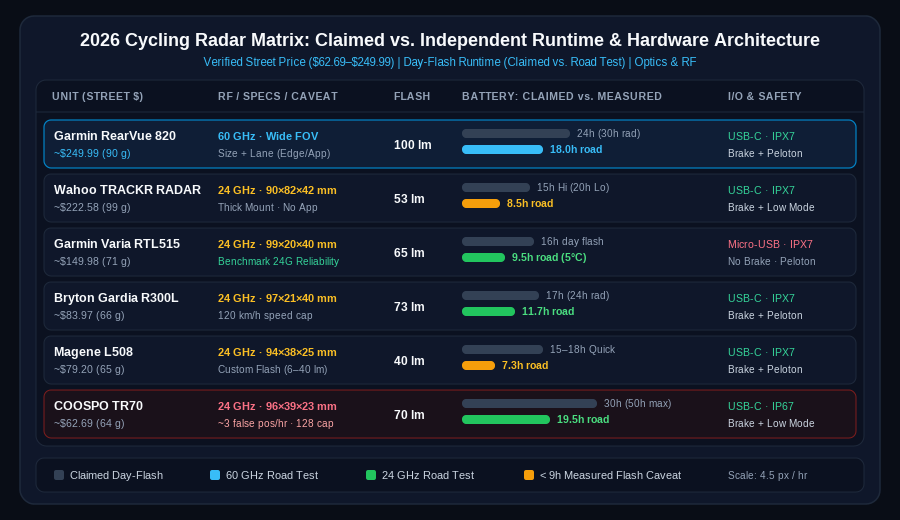
| Garmin Varia RearVue 820 | 60 GHz | 90 g | 98.9 x 25.9 x 43.2 | 100 lm | 24 h Day Flash | 18.0 h Day Flash | $299.99 (~$249.99) |
| Wahoo TRACKR RADAR | 24 GHz | 99 g bare, 116 g with mount | 90.0 × 82.0 × 42.0 mm | 53 lm | 15 h High Flash | 8.5 h flash | $249.99 (~$222.58) |
| Garmin Varia RTL515 | 24 GHz | 71 g | 98.6 x 19.7 x 39.6 | 65 lm | 16 h Day Flash | 9.5 h (5°C test) | $199.99 (~$149.98) |
| Bryton Gardia R300L | 24 GHz | 66 g | 97.0 x 20.9 x 40.0 | 73 lm | 17 h Day Flash | 11.7 h Day Flash | $129.95 (~$83.97) |
| Magene L508 | 24 GHz | 65 g | 94.0 x 38.0 x 25.0 | up to 40 lm | 15–18 h Quick Flash | 7.3 h Day Flash | $129.00 (~$79.20) |
| COOSPO TR70 | 24 GHz | 64 g | 96.0 x 39.0 x 23.0 | 70 lm | 30 h Day Flash | 19.5 h Day Flash | $73.99 (~$62.69) |
MSRP figures are the baseline. Street prices are approximate and move by retailer. Independent runtimes come from third-party road tests, with differing conditions between units, so compare them as a rough guide and not as a controlled benchmark.
6. Unit Breakdowns
Garmin Varia RearVue 820 (60 GHz)
At 90 g (98.9 x 25.9 x 43.2 mm), it is the heaviest Garmin radar here. Its four light modes are 100 / 40 / 25 / 8 lm (Day Flash, Night Flash, Solid and Peloton-class modes). Garmin claims 24 h Day Flash, 30 h Radar-Only, 15 h Peloton and 10 h Solid and Night Flash. Cyclists Hub measured 18.0 h in Day Flash, which is about three quarters of the claim. That is a fair real-world result, and well above the 24 GHz units’ independent figures. The caveat again: extended vehicle-size and lane-change telemetry needs a compatible Garmin Edge or the Varia app.
Check Garmin Varia RearVue 820 →Wahoo TRACKR RADAR (24 GHz)
At 99 g bare (116 g with mount), it is the heaviest 24 GHz unit. Claimed runtime is 15 h High Flash (53 lm), 20 h Low Flash (18 lm), 10 h High Steady (21 lm), 15 h Low Steady (10 lm), 17 h Battery Saver and 55 h Light Off. Independent testing recorded 8.5 h in flash, which is a large shortfall against the 15 h claim. Two practical caveats: Wahoo’s quarter-turn mount tabs are thicker than Garmin saddle-rail mounts, so check fit on your seatpost, and there is no live phone radar display.
Check Wahoo TRACKR RADAR →Garmin Varia RTL515 (24 GHz)
The long-running benchmark: 71 g, 98.6 x 19.7 x 39.6 mm, 65 lm Day Flash. Garmin claims 16 h, and independent testing in a 5°C ride gave 9.5 h, so expect less in cold weather. Hardware caveats: Micro-USB charging and no brake accelerometer, so it does not brighten when you slow down.
Check Garmin Varia RTL515 →Bryton Gardia R300L (24 GHz)
At 66 g (97.0 x 20.9 x 40.0 mm) with 73 lm, it has the brightest 24 GHz light in the group. Claimed runtime is 17 h Day Flash and 24 h Radar-Only, against 11.7 h measured in Day Flash. It does support Group Ride (Peloton) mode, and its upper relative-speed cap is 120 km/h. For the money, it has the strongest balance of output, runtime and group-ride behaviour.
Check Bryton Gardia R300L →Magene L508 (24 GHz)
65 g, 94.0 x 38.0 x 25.0 mm, with output from 6 to 40 lm (40 lm Quick Flash). Claimed runtime is 15–18 h Quick Flash and 19 h Radar-Only. Independent Day Flash testing gave 7.3 h, the weakest runtime result here. It is the lowest-output light in the group, so it leans on radar over conspicuity.
Check Magene L508 →COOSPO TR70 (24 GHz)
The budget pick: 64 g, 96.0 x 39.0 x 23.0 mm, IP67, and 70 lm. Claimed runtime is 30 h Day Flash and up to 40–50 h at maximum, with 19.5 h measured in Day Flash. Testing caveats matter at this price. Cyclists Hub v1.0.8 testing found roughly 3 false positives per hour and a 128 km/h speed cap, and GPLama reported early-clear behaviour on some trailing vehicles. For flat rural riding with few roadside objects it is hard to argue with the price. In clutter-heavy settings, expect more phantom alerts.
Check COOSPO TR70 →7. Which One Should You Buy?
- You ride a current Garmin Edge and want the most data: RearVue 820, because it is the only unit here that can show vehicle size and lane-change information, and it has the best independent runtime.
- You use a Wahoo or Hammerhead head unit: the RearVue 820’s extra telemetry will not display, so a 24 GHz unit gives you the same dots for much less. The Bryton Gardia R300L is our value pick.
- You want the proven benchmark: Garmin RTL515, if you accept Micro-USB, no brake accelerometer and cold-weather runtime.
- Tightest budget: COOSPO TR70, understanding its false-positive and early-clear caveats.
- Group rides: Gardia R300L (Group Ride mode confirmed) or the RearVue 820 (Peloton mode).
- Long rides without recharging: RearVue 820 (18.0 h independent) or TR70 (19.5 h independent).
Limits of this analysis. We did no in-house RF testing. Several physics points are inference from automotive radar literature at 77 GHz and 24 GHz, not measurements of these products. Beam angles, detection range claims and antenna details for individual units are not independently verified here, and we deliberately omit them. Specifications are manufacturer-stated and can change with firmware.
Final Buying Decision
References
- Chao et al. (2025). Overtaking, rear-end and door crashes involving bicycles in the UK. PLOS ONE. DOI: 10.1371/journal.pone.0315692
- Wanvik (2009). Road lighting and crash outcomes. Accident Analysis & Prevention. DOI: 10.1016/j.aap.2008.10.003
- Farah et al. (2019). Car-to-cyclist overtaking. Transportation Research Part F, pp. 226–239. DOI: 10.1016/j.trf.2019.04.026
- Hasch et al. (2012). Millimeter-wave automotive radar. IEEE Trans. Microwave Theory and Techniques. DOI: 10.1109/TMTT.2011.2178427
- Patole et al. (2017). Automotive radar signal processing. IEEE Signal Processing Magazine. DOI: 10.1109/MSP.2016.2628914
- Villeval et al. (2014). 24 GHz automotive radar. IEEE Radar Conference, pp. 1237–1240. DOI: 10.1109/radar.2014.6875787
- Lee et al. (2017). Radar-based road-user classification. IET Radar, Sonar & Navigation, 11(10):1589–1596. DOI: 10.1049/iet-rsn.2017.0126
- Chen et al. (2017). Water-covered radomes and automotive radar. European Radar Conference, pp. 139–142. DOI: 10.23919/eurad.2017.8249166
Published by SportTechConsulting Research Lab.