
Mid-Range GPS Running Watches 2026: L1/L5 Multipath Physics, Chassis Inertia & a Six-Unit Hardware Review
Engineering review of six mid-range GPS running watches: L1/L5 multipath rejection, chassis mass and PPG coupling, battery, offline maps and buyer guidance.
SportTechConsulting Research Lab
Sensor Architecture & Biomechanics Research
Bottom line: Dual-band L1/L5 GNSS is no longer a flagship feature. Five of the six watches here have it, and the odd one out is the Garmin Forerunner 165 (single-band L1 only). The real differences now are weight, battery under dual-band load, offline maps and the training-load platform. If you want maps, choose the COROS PACE Pro. If you want the lightest chassis and the longest battery, choose the COROS PACE 4. If you want Garmin’s Training Readiness, choose the Forerunner 265. If you want the cheapest dual-band entry, choose the Suunto Run.
The evaluated tier is roughly $199–$450 MSRP. Six watches are covered: the Garmin Forerunner 265, COROS PACE Pro, Polar Vantage M3, COROS PACE 4, Garmin Forerunner 165 and Suunto Run. Prices throughout are MSRP baselines only, because street prices move constantly.
Methodology. This is a first-principles engineering analysis by SportTechConsulting Research Lab, built on manufacturer specifications and peer-reviewed literature. SportsTech Consulting conducted no in-house RF or optical bench testing. The inertial-force and power-budget calculations below are first-principles engineering models, and where we use assumed inputs (for example a peak wrist acceleration), we say so. Where we reason beyond published data, we label it as inference.
For neighbouring reading, see our Garmin Fenix 8 biomechanics review for the flagship tier, Suunto Race vs. Vertical battery benchmark for independent runtime methodology, and upper-arm PPG vs. budget ECG chest straps if wrist heart rate is not good enough for your intervals. The broader context is in our best endurance smartwatches of 2026 guide.
1. GNSS: Why a Second Frequency Matters
A GNSS receiver solves for position by measuring pseudoranges to at least four satellites. Each measured pseudorange contains the true geometric range plus clock terms, an ionospheric delay (I), a tropospheric delay (T), a multipath error (M) and receiver noise. For a runner, the two largest uncorrected terms are usually multipath (reflections off buildings and cliffs) and ionospheric delay.
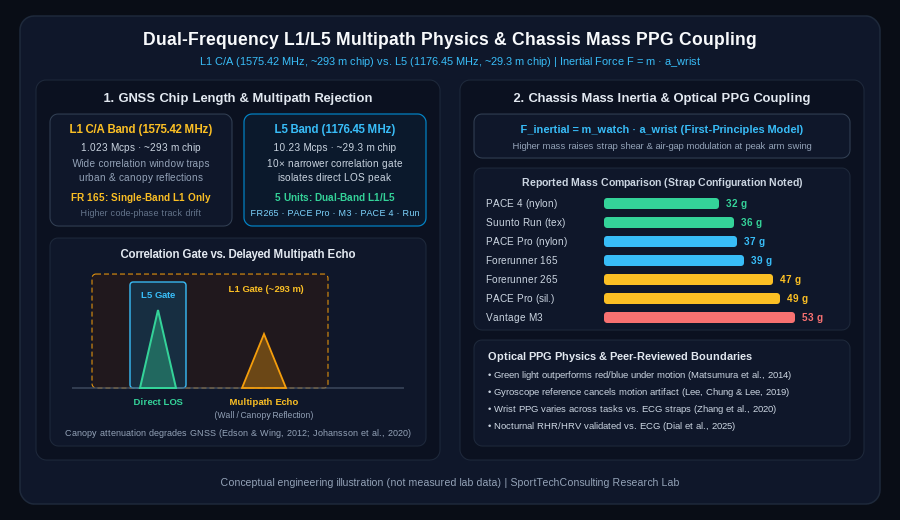
Chip length and multipath
The civil L1 C/A signal runs at a chipping rate of 1.023 MHz, which makes one chip about 293 m long. L5 (and Galileo E5a) runs at 10.23 MHz, so one chip is about 29.3 m long. That is ten times shorter.
A reflected signal that arrives later than the direct one by less than a chip length overlaps the direct correlation peak and biases the receiver’s code-phase estimate. The practical consequence, as a first-principles inference, is that a reflection with extra path length above roughly 29.3 m (a delay above 97.8 ns) falls outside the L5 correlation peak, while on L1 the same reflection can still distort it. The L5 correlation peak is also steeper, which narrows noise-driven jitter. L5 also carries a higher minimum received power than L1.
Multipath still occurs on L5, and shorter reflection paths (say, a wall a few metres from your running line) affect both bands. The benefit is concentrated in longer-delay reflections, such as a street canyon.
Ionospheric delay
To first order, ionospheric group delay is I = 40.3 × TEC / f², where TEC is total electron content along the signal path. Because delay depends on frequency, a receiver that measures both L1 and L5 can form an ionosphere-free combination: ρ_IF = (f1² × ρ1 − f5² × ρ5) / (f1² − f5²). This removes the first-order ionospheric term directly from measurements, without relying on a broadcast model. A single-band receiver such as the Forerunner 165 has to rely on that broadcast model, which corrects only part of the delay on average.
What the literature says
- Johansson et al. (2020) evaluated GPS sport watches measuring distance in an ultramarathon race, a useful reminder that watch GNSS error shows up as distance error over long outdoor efforts. DOI: 10.1177/1747954119899880
- Edson & Wing (2012) is a forestry study of a mapping-grade GPS receiver under forest canopy, not a running-watch trial. We cite it only as evidence that canopy attenuates and scatters GNSS signals and degrades positioning. DOI: 10.5849/forsci.11-015
- Lepley et al. (2026) reviews consumer smartwatch technology in health and performance research, covering validity, limitations and real-world use. It is a good source for the general caveat that consumer wearable validity depends on conditions and context. DOI: 10.3390/s26144486
None of these papers tests the six watches in this article, and we make no claim about how any specific unit scores. Our conclusion that dual-band should reduce multipath-driven track error under canopy and between buildings is an inference from the signal physics and the canopy evidence.
SatIQ
Garmin’s SatIQ (AutoSelect) chooses between GNSS modes based on conditions. Garmin’s official Forerunner 265 figures show what that mode switching buys: up to 14 hours in All-Systems plus Multi-Band GNSS, 16 hours with SatIQ AutoSelect and 20 hours in GPS-only. The Forerunner 165 has no multi-band mode and no SatIQ.
2. Chassis Mass, Strap Coupling and Optical PPG
Wrist photoplethysmography measures blood-volume changes by emitting light into the skin and detecting the backscatter. During running, every foot strike sends an impact up the arm, and the watch body is a mass resting on viscoelastic skin and held by a strap.
A simple inertia model
Model the chassis as a mass on a spring and damper (skin plus strap). The inertial force trying to lift or shear the sensor window off the skin is:
F_inertial = m × a
Take an assumed, illustrative peak wrist acceleration of 4 g (39.24 m/s²). This is an assumed input, not a measured value for any of these watches.
- COROS PACE 4, nylon band (32 g): 0.032 kg × 39.24 m/s² = about 1.26 N
- Polar Vantage M3 (53 g): 0.053 kg × 39.24 m/s² = about 2.08 N
On this simple model the Vantage M3 sees roughly 66% more inertial force at the same acceleration. The model ignores strap tightness, strap material, sensor-window geometry and skin properties, all of which change the real outcome. Treat this as a direction-of-effect argument: lighter chassis, all else equal, make it easier to keep the sensor window pressed to the skin. It is not a prediction of a heart-rate error.
Wavelength and motion
Matsumura et al. (2014) compared light colours for photoplethysmographic heart-rate measurement in the presence of motion artifact. Green light gave better results than red or blue, which is why wrist watches use green LEDs as their primary channel. DOI: 10.1371/journal.pone.0091205
Cadence lock
Running cadence of roughly 160–190 steps per minute (about 2.7–3.2 Hz) overlaps the heart-rate band of a hard effort. Motion artifact at stride frequency can therefore be mistaken for pulse, which is the classic cadence lock failure.
Zhang et al. (2020), a systematic review and meta-analysis of wrist-worn PPG devices for heart rate, is the right reference for the general point that accuracy varies across devices and activities. DOI: 10.1080/02640414.2020.1767348
Lee, Chung & Lee (2019) is the relevant algorithm reference: it uses gyroscope signals to cancel motion artifact in wearable PPG. DOI: 10.1109/JSEN.2018.2879970 Motion-reference cancellation works best when the artifact correlates with the inertial reference. A chassis that lifts off the skin and lets ambient light in is a harder case, which is one more reason fit and strap tension matter more than anything printed on a spec sheet.
When to use a strap or armband
Wrist optics are weakest in short hard intervals, cold weather and gripping. For those, pair the watch with an ECG chest strap (see our Polar H10 vs. Garmin HRM-Pro Plus comparison) or an upper-arm optical band.
Nocturnal HRV
Dial et al. (2025) validated nocturnal resting heart rate and heart rate variability in consumer wearables against an ECG reference. DOI: 10.14814/phy2.70527 That supports using overnight HRV trends from wrist devices, where motion is low. It does not mean wrist PPG is equivalent to ECG during hard running. Use rolling baselines and ignore single-night noise.
3. Battery Physics: AMOLED and GNSS
A mid-range watch has a battery on the order of a few hundred milliamp-hours, which is only about one or two watt-hours. Two things dominate the draw during an activity: the GNSS front end and the AMOLED display.
- GNSS. A dual-band receiver runs two RF paths and more correlators than a single-band one, so we should expect it to draw more than single-band tracking. That is why every vendor publishes separate single-band, all-systems and dual-band runtimes, and why the dual-band number is always smaller.
- Display. An AMOLED pixel emits its own light, so power scales with brightness and with how many pixels are lit. A mostly black running screen is cheap. A bright full-screen map is expensive. This is why map-capable watches typically push dark map themes and aggressive wrist-down timeouts.
We deliberately do not publish milliwatt budgets for individual watches. Those are not published by the manufacturers, and we did no bench testing. Use the vendor runtimes below instead, and use the dual-band figure when comparing units that run dual-band.
4. Training Platforms, Maps and Storage
- Garmin (Forerunner 265, 165): Firstbeat-based analytics. The Forerunner 265 has Training Readiness, Training Status, Acute Load and multisport modes. The Forerunner 165 includes HRV Status, Body Battery, Morning Report, a barometric altimeter and Recovery Time, but omits Training Readiness, Training Status, Acute Load and Multisport/Triathlon modes.
- COROS (PACE Pro, PACE 4): the EvoLab platform, with Base Fitness and Load Impact metrics.
- Polar (Vantage M3): Training Load Pro (cardio, muscle and perceived load) with Nightly Recharge recovery.
- Suunto (Run): training metrics via the Suunto app, plus onboard music.
Maps. Only the COROS PACE Pro (32 GB of global offline topo maps) and Polar Vantage M3 carry offline maps in this group. The other four use breadcrumb trails. A breadcrumb line tells you where you have been, and it is enough for a road race or a well-known route. It tells you nothing if the trail is blocked and you need an alternative.
Music. The PACE Pro has 32 GB of offline MP3 storage, the PACE 4 has 4 GB of offline MP3 storage (no third-party streaming such as Spotify), the Suunto Run has 4 GB of offline MP3 storage, and the Forerunner 265 has onboard music storage. The Forerunner 165 gets onboard audio only on the Music SKU (+$50 MSRP). The Vantage M3 has none.
5. Spec Matrix
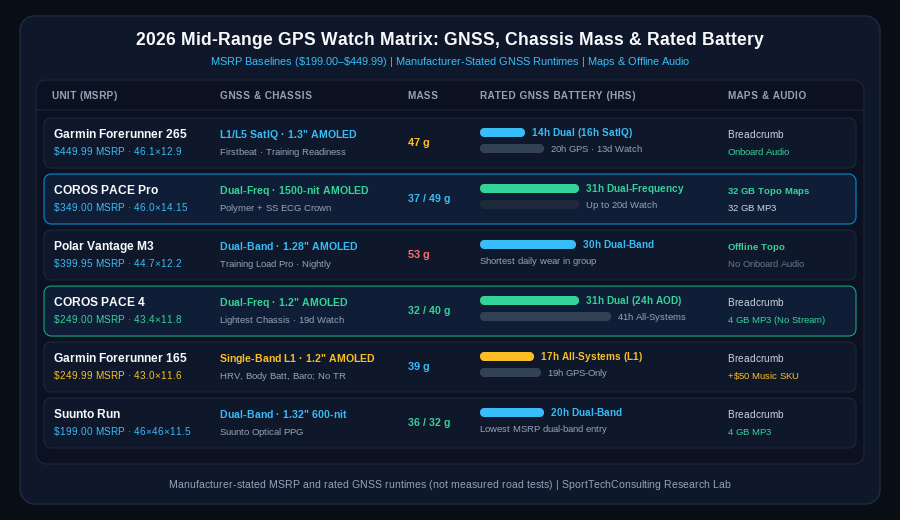
| Unit | MSRP | GNSS | Weight | Size (mm) | Display | GPS battery | Maps | Music |
|---|---|---|---|---|---|---|---|---|
| Garmin Forerunner 265 | $449.99 | Dual-band L1/L5 with SatIQ | 47 g (silicone) | 46.1 × 12.9 | 1.3” AMOLED | 14 h All-Systems + Multi-Band, 16 h SatIQ, 20 h GPS-only | Breadcrumb | Onboard |
| COROS PACE Pro | $349.00 | Dual-frequency | 37 g (nylon) / 49 g (silicone) | 46.0 × 14.15 | 1.3” AMOLED, 1500 nits | 31 h Dual-Frequency | 32 GB global offline topo | 32 GB MP3 |
| Polar Vantage M3 | $399.95 | Dual-band | 53 g | 44.7 × 12.2 | 1.28” AMOLED | 30 h dual-band | Offline topo | None |
| COROS PACE 4 | $249.00 | Dual-frequency | 32 g (nylon) / 40 g (silicone) | 43.4 × 11.8 | 1.2” AMOLED | 31 h Dual-Frequency (24 h AOD), 41 h All-Systems | Breadcrumb | 4 GB MP3 |
| Garmin Forerunner 165 | $249.99 | Single-band L1 All-Systems | 39 g (silicone) | 43.0 × 11.6 | 1.2” AMOLED | 17 h All-Systems, 19 h GPS-only | Breadcrumb | Music SKU only (+$50) |
| Suunto Run | $199.00 | Dual-band | 36 g (textile strap), 32 g (case) | 46 × 46 × 11.5 | 1.32” AMOLED, 600 nits | 20 h dual-band | Breadcrumb | 4 GB MP3 |
Smartwatch-mode battery (manufacturer-stated): Forerunner 265 up to 13 days, PACE Pro up to 20 days, PACE 4 up to 19 days. Prices are MSRP baselines; the tier runs about $199–$450.
6. Unit-by-Unit Verdicts
Garmin Forerunner 265 (~$449.99 MSRP)
The Garmin analytics pick: Training Readiness, Training Status, Acute Load, HRV Status and multisport modes, with dual-band and SatIQ. Battery is the trade-off. Garmin’s own figures are up to 14 hours in All-Systems plus Multi-Band, 16 hours with SatIQ AutoSelect and 20 hours GPS-only, which is well behind both COROS watches in dual-band mode. Up to 13 days in smartwatch mode. No offline maps.
Check Garmin Forerunner 265 →COROS PACE Pro (~$349.00 MSRP)
The mapping pick. A fiber-reinforced polymer case and bezel, with a stainless steel digital crown that carries the ECG sensor. It weighs 37 g on nylon and 49 g on silicone, measures 46.0 × 14.15 mm, and has a 1500-nit AMOLED, 31 hours of Dual-Frequency GPS, 32 GB of global offline topo maps and 32 GB of offline MP3 storage. It is the thickest watch here, so check wrist fit.
Check COROS PACE Pro →Polar Vantage M3 (~$399.95 MSRP)
Biosensing and maps, with Training Load Pro and Nightly Recharge. At 53 g it is the heaviest here, which is the direction-of-effect concern from our inertia model, and it has the shortest smartwatch battery of the group. If you value Polar’s recovery tools and offline maps, it fits. Fit the strap snugly.
Check Polar Vantage M3 →COROS PACE 4 (~$249.00 MSRP)
The lightweight, long-battery pick: 32 g on nylon or 40 g on silicone, 31 hours of Dual-Frequency GPS (24 hours with always-on display), 41 hours All-Systems, and 19 days of daily wear. It includes 4 GB of offline MP3 storage (no streaming services). It has breadcrumb navigation only, no maps.
Check COROS PACE 4 →Garmin Forerunner 165 (~$249.99 MSRP)
A good Garmin interface with real recovery tools: HRV Status, Body Battery, Morning Report, a barometric altimeter and Recovery Time. What it omits is the point: no Multi-Band L1/L5 (single-band L1 All-Systems only, 17 hours All-Systems or 19 hours GPS-only), no Training Readiness, Training Status or Acute Load, and no multisport or triathlon modes. The Music SKU adds onboard audio for +$50 MSRP. Because the Suunto Run and PACE 4 both offer dual-band for less or similar money, buy this one for the Garmin ecosystem, not for GNSS.
Check Garmin Forerunner 165 →Suunto Run (~$199.00 MSRP)
The cheapest dual-band entry. It measures 46 × 46 × 11.5 mm, weighs 36 g with the textile strap (32 g for the case), has a 1.32” 600-nit AMOLED, 20 hours of dual-band GPS and 4 GB of offline MP3 storage. Its optical sensor is Suunto’s optical PPG. It has breadcrumb navigation only, and it is dimmer than the COROS PACE Pro.
Check Suunto Run →7. Which One Should You Buy?
- Offline maps and trail running: COROS PACE Pro. The Polar Vantage M3 is the alternative if you prefer Polar’s recovery tools.
- Lightest, longest battery: COROS PACE 4.
- Garmin ecosystem and Training Readiness: Forerunner 265. Accept the shorter dual-band battery.
- Tightest budget with dual-band: Suunto Run.
- Garmin on a budget: Forerunner 165, with the single-band GNSS trade-off understood.
- Hard intervals or cold-weather training: any of these, plus a chest strap or upper-arm band.
Limits of this analysis. SportsTech Consulting did no in-house RF or optical bench testing. The inertia model uses an assumed acceleration and ignores strap and skin properties. The cited papers do not test these specific watches. Specifications are manufacturer-stated and can change with firmware and hardware revisions.
Final Buying Decision
References
- Johansson, R. E., Adolph, S. T., Swart, J., & Lambert, M. I. (2020). Accuracy of GPS sport watches in measuring distance in an ultramarathon running race. International Journal of Sports Science & Coaching, 15(2):212–219. DOI: 10.1177/1747954119899880
- Lepley, A. S., Davis, F., Melvin, A. C., & Zhao, Z.-Y. (2026). Consumer Smartwatch Technology in Health and Performance Research: Validity, Limitations, and Real-World Applications. Sensors, 26(14):4486. DOI: 10.3390/s26144486
- Edson, C., & Wing, M. G. (2012). Tree Location Measurement Accuracy with a Mapping-Grade GPS Receiver under Forest Canopy. Forest Science, 58(6):567–576. DOI: 10.5849/forsci.11-015
- Zhang, Y., Weaver, R. G., Armstrong, B., Burkart, S., Zhang, S., & Beets, M. W. (2020). Validity of wrist-worn photoplethysmography devices to measure heart rate: A systematic review and meta-analysis. Journal of Sports Sciences, 38(17):2021–2034. DOI: 10.1080/02640414.2020.1767348
- Lee, H., Chung, H., & Lee, J. (2019). Motion Artifact Cancellation in Wearable Photoplethysmography Using Gyroscope. IEEE Sensors Journal, 19(3):1166–1175. DOI: 10.1109/JSEN.2018.2879970
- Matsumura, K., Rolfe, P., Lee, J., & Yamakoshi, T. (2014). iPhone 4s photoplethysmography: which light color yields the most accurate heart rate and normalized pulse volume using the iPhysioMeter Application in the presence of motion artifact? PLoS ONE, 9(3):e91205. DOI: 10.1371/journal.pone.0091205
- Dial, M. B., Hollander, M. E., Vatne, E. A., Emerson, A. M., Edwards, N. A., & Hagen, J. A. (2025). Validation of nocturnal resting heart rate and heart rate variability in consumer wearables. Physiological Reports, 13(16):e70527. DOI: 10.14814/phy2.70527
Published by SportTechConsulting Research Lab.
Frequently Asked Questions
Which mid-range 2026 GPS running watch lacks dual-frequency L1/L5 GNSS?
Among the six units compared in our mid-range 2026 review, the Garmin Forerunner 165 is single-band L1 only, whereas the Forerunner 265, COROS PACE Pro, COROS PACE 4, Polar Vantage M3, and Suunto Run all include dual-band L1/L5 GNSS.
Which mid-range running watch includes offline maps?
Both the COROS PACE Pro and Polar Vantage M3 include downloadable offline maps, making them stronger choices for trail navigation than map-less mid-range models.
How do lighter watch chassis affect wrist optical heart rate accuracy?
Lower chassis mass reduces inertial shear torque during high-cadence arm swing, lowering mechanical motion artifact at the wrist photodiode—though intense intervals or cold weather still benefit from an ECG chest strap or upper-arm band.
What is the lowest-MSRP entry into dual-band L1/L5 running GNSS in this group?
The Suunto Run provides the lowest baseline MSRP entry into dual-band L1/L5 GNSS in this six-watch comparison, while the COROS PACE 4 prioritizes minimal chassis weight and maximum battery endurance.
SportTechConsulting Research Lab
Get Engineering & Sensor Briefs
Receive concise firmware, PPG/ECG biomechanics, and GNSS architecture updates. Zero spam, no affiliate links in emails—all hardware references link back to our full on-site guides.
See our Privacy & Affiliate Disclosure for data handling details.